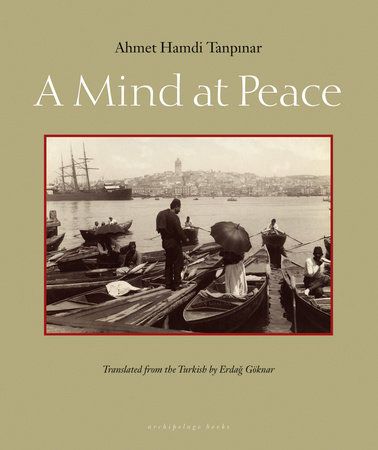
Tanpinar (1901-62) was a formative figure in modern Turkish letters, although 50 years after his death, his career in English is just getting off the ground. His monumental A Mind at Peace (1949), which Orhan Pamuk has called “the greatest novel ever written about Istanbul,” found its way into English in 2008 (Archipelago). Set just before World War II, it conjures on a vast scale the world of Istanbul during the early Turkish Republic, a time when modern Western values were abruptly imposed upon a people and a culture unprepared for them. The ramshackle modernity that resulted, in which Ottoman history and tradition were largely written over, became Tanpinar’s lasting subject: the “void,” as he once described it, of a people “suspended between two lives.” — New York Times Book Review
[A] masterpiece. . .[A] honeyed, searching, and melancholy epic. . .The novel is as much about its setting and colors as about the stories and wonderfully eccentric and varied panoply of characters. . .One of the 20th century’s notable literary love stories and cultural watersheds. — The Los Angeles Times
The greatest novel ever written about Istanbul. — Orhan Pamuk
Tanpinar′s sweeping literary masterpiece is a love story of his native Turkey and of The flesh…His lyricism and resonant plot will leave U.S. readers wondering why they’ve had to wait so long to read this exquisite novel. — Publishers Weekly
Every page is full of sharp insights into human nature, delivered with a linguistic confidence that cracks like a whip and warms one from the inside with a glow of recognition—the recognition that no matter how far away we think we might be from one another in time and space, we are all distilled from the very same mixture of passion and compassion, intelligence and foolishness. — Ugur Akinci
A beautifully melodic picture of Istanbul and the Bosphorus during a crossroad of Turkish and world history. We shouldn’t have had to wait this long for such an important work. — Literary Fiction Review
Written by the man who almost single-handedly defined the modern Turkish novel, A Mind At Peace follows a group of westernized, urban intellectuals in 1930s Istanbul as they drift through the city in a permanent state of ennui, seemingly caught between the past and the present, tradition and modernity, the East and the West. — Reza Aslan
His great novel combines the emotional storminess of Dostoevsky with the refined artificiality and cruel psychological analysis of Marcel Proust. — Ha’aretz