
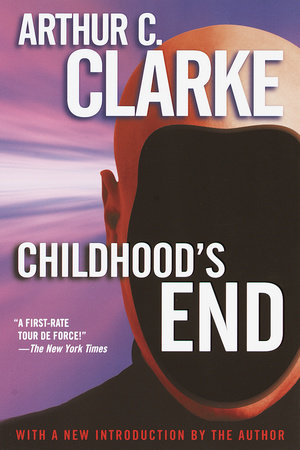

Childhood’s End is one of the defining legacies of Arthur C. Clarke, the author of 2001: A Space Odyssey and many other groundbreaking works. Since its publication in 1953, this prescient novel about first contact gone wrong has come to be regarded not only as a science fiction classic but as a literary thriller of the highest order.
Spaceships have suddenly appeared in the skies above every city on the planet. Inside is an intellectually, technologically, and militarily superior alien race known as the Overlords. At first, their demands seem benevolent: unify Earth, eliminate poverty, end war. But at what cost? To those who resist, it’s clear that the Overlords have an agenda of their own. Has their arrival marked the end of humankind . . . or the beginning?
Praise for Childhood’s End
“A first-rate tour de force.”—The New York Times
“Frighteningly logical, believable, and grimly prophetic . . . Clarke is a master.”—Los Angeles Times
“There has been nothing like it for years; partly for the actual invention, but partly because here we meet a modern author who understands that there may be things that have a higher claim on humanity than its own ‘survival.’ ”—C. S. Lewis
“As a science fiction writer, Clarke has all the essentials.”—Jeremy Bernstein, The New Yorker
Author
Arthur C. Clarke
Sir Arthur C. Clarke (1917-2008) wrote a hundred books and more than a thousand short stories and essays covering science fiction and science fact in a career spanning more than six decades. Among his bestselling novels are Childhood’s End, 2001: A Space Odyssey, and Rendezvous with Rama. In 1945, he proposed global broadcasting via communication satellites in geostationary orbit. One of his short stories inspired the World Wide Web, while another was expanded into 2001: A Space Odyssey, which he cowrote with Stanley Kubrick. Born in Somerset, England, Clarke was educated at King’s College, London. He worked in the British civil service and the Royal Air Force before turning full-time author in 1950. The recipient of dozens of awards, fellowships, and honorary doctorates, Clarke had both an asteroid and dinosaur species named after him. Queen Elizabeth II gave him a knighthood in 1998. Clarke lived in Sri Lanka since 1956, engaged in diving, astronomical observations, and underwater tourism.
Learn More about Arthur C. Clarke
