




READERS GUIDE
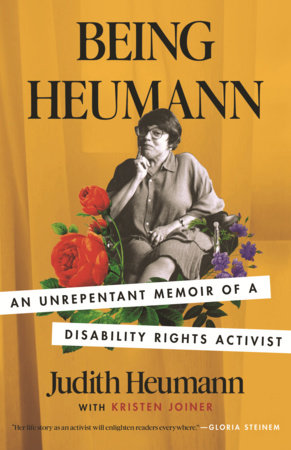
Judy Heumann spent her life fighting for disabled people to be able to take their place in society as equal citizens. She argued that disability is not a problem to be fixed but a natural part of the human experience—and that attitudes toward disabled people are the real barrier they face.These questions are an invitation to sit with Judy’s life and ask where her experiences touch your own.
Questions and Topics for Discussion
1. Early in her life, Judy is denied entry to school because she is considered a “fire hazard.” After she finishes college and has passed her exams to become a teacher, she is denied her teaching certificate on medical grounds. Later, when she fights for the Section 504 regulations to be signed for all disabled people, she is told that ensuring access is too expensive. Judy’s exclusion is explained away alternately as a safety issue, a medical problem, and a cost issue. Judy writes: “The truth is, the status quo loves to say no. It is the easiest thing in the world to say no, especially in the world of business and finance. But for the first time we were discussing civil rights, and no other civil rights issue has ever been questioned because of the cost.” What does Judy mean by this? How do these explanations appear reasonable and practical on the surface? What are they hiding?
2. The idea that disabled people don’t need pity, charity, or admiration but require equal rights instead is a central theme of the book. What are the unspoken stories you have absorbed about disability and disabled people?
3. The 1977 sit-in ultimately succeeded partly due to the support of a variety of very different groups and political organizations. For example, the Black Panthers delivered food, unions and churches sent endorsements of support, and the sit-in itself relied on previously separate disability groups coming together in a coalition. What type of leadership on the part of Judy and the other leaders made this type of coalition building possible? When have you experienced a moment of strength in your life that relied on the support of other people or collective action—versus going it alone?
4. Judy was raised to believe that “no” was not always the final answer, which her mother modeled for her with a fierce determination. She writes, “The day-to-day work of fighting fell on my mother, which I take as a sign. Because if the universe really hadn’t wanted me to go to school, it wouldn’t have made Ilse Heumann my mother. Telling Ilse Heumann that something wasn’t possible was a big mistake.” When in your own life has refusing to accept a “no” changed what became possible? Is there a “no” you’re still living with that might be worth questioning?
5. Throughout her life, Judy had to fight to simply be seen—to be counted as part of “everyone.” For example, when her mother took her to a public school for her first day of kindergarten and was told that Judy could not attend due to her use of a wheelchair,the implicit meaning was: This school is for everyone except those who use wheelchairs. Whose experiences are still left out despite institutions, schools, workplaces, or communities saying they serve “everyone”? What would it take to widen the circle?
6. Being Heumann, the movie, focuses on the events of the sit-in and tells the story of several of the protesters, alongside Judy’s story. Why do you think the filmmaker made this choice? What can a film do that a book cannot? And what can a book do that a film cannot?
7. Judy writes, “Our anger was a fury sparked by profound injustices. Wrongs that deserved ire. And with that rage we ripped a hole in the status quo.” The emotion of anger runs through this book—not as bitterness but as fuel. Yet, at the same time, Judy never writes anyone off or dismisses anyone as unreachable. When has anger helped you see your values clearly, helped you set a boundary, or confront an injustice? How do you keep asking for what you want without writing anyone off, even when you’re angry?
8. Judy writes about her parents and how they influenced her later actions. She describes how the dinner conversations with her father, growing up, taught her to argue. And how her mother’s participation in community life affected her awareness of others. She says, “My parents weren’t obstinate or antiauthoritarian; they were thinkers. They had learned what happens when hatred and inhumanity are accepted. Both my father and my mother were brave people who lived by their values. They had personally experienced what happens when an entire country chooses not to see something simply because it is not what they wish to see. As a result, they never accepted anything at face value. When something doesn’t feel right, they taught us, you must question it—whether it is an instruction from an authority or what a teacher says in class.” How do these influences affect Judy’s choices and accomplishments? Who has influenced you and in what way? Who do you influence?
9. So much of Judy’s fight was about being able to access what much of society takes for granted—from classroomsand the workplace to transportation. Her inability to access these areas affected her ability to participate fully in society, for example, when she and her friends couldn’t go to theaters or restaurants because of the lack of space for wheelchairs, or when disabled activists couldn’t physically get to the protests because they couldn’t get on a bus. Where have you noticed that access, or lack of access, influences who gets to be a part of everyday community places and events? What barriers prevent some people from being present and visible in the course of our everyday lives?
10. Some of the people who fought with Judy did not live to see the end result of their incredible contribution. They left behind a legacy, and the fight for the inclusion of people with disabilities is very present still today. What are the issues that the disability rights movement faces today? How could you support their fight?


