
Seasons of Fury Reader’s Guide
By Rozina Ali
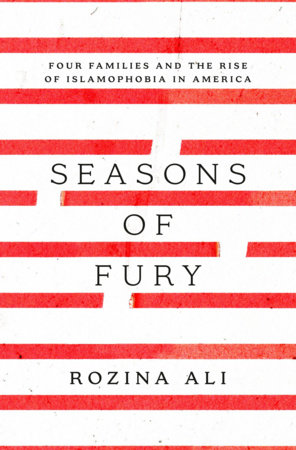



1. The book spans decades of Islamophobia through policy shifts and political events, but it remains grounded in the story of four families. How did this storytelling choice affect your understanding of history? Did it make the larger political forces feel more immediate or personal?
2. Author Rozina Ali suggests that the rise of Islamophobia was not simply the result of ancient prejudice but of specific political decisions, media narratives, and institutional actions. Which moments in the book seemed like turning points that could have gone differently?
3. Several families came to the United States seeking opportunity, freedom, or safety. How did their experiences affirm—or undermine—the promises America made to them? How does the book challenge or complicate the idea of the “American Dream”?
4. Abdeen Jabara’s story spans nearly the entire history covered in the book—connecting his experience to the Palestinian struggle, Arab American activism, surveillance, civil rights, and post-9/11 America. What does his life reveal about the continuity of anti-Muslim suspicion before and after 9/11?
5. At different points, those featured in the book are told to stay quiet, avoid attention, change how they present themselves, or prove their loyalty. What are the emotional and psychological costs of being either highly visible or deliberately invisible in public life?
6. The book examines surveillance as more than a government practice—it becomes a way of life. From FBI monitoring to informants, secret evidence, and self-censorship within families, the idea that “the walls have ears” appears repeatedly. Which examples felt most disturbing, and why?
7. Ali argues that events in Palestine, Lebanon, Iraq, Afghanistan, and elsewhere profoundly shaped the lives of American Muslims. How effectively does the book connect international conflicts to everyday experiences in the United States?
8. Many people think of the War on Terror as something that happened overseas. How does Seasons of Fury broaden or challenge common understandings of the War on Terror? In what ways has it transformed American institutions, laws, communities, and civil liberties at home?
9. The four families express and practice Islam differently. How does the author resist presenting Muslims as a monolithic group? Which depictions of faith stood out to you?
10. The book frequently contrasts “good Muslims” and “bad Muslims.” Who gets to define those labels? How are they used by governments, media figures, activists, and communities themselves? Do you see similar dynamics operating in other contexts today?
11. How did the stories of the Siraj family, particularly Matin Siraj, affect your understanding of entrapment, terrorism prosecutions, and the justice system?
12. How does the Omar family’s conflict with “Mr. Happy” illuminate the ways prejudice operates at a local and personal level? What does Mr. Happy and the Omar family’s story suggest about the effectiveness of hate crime legislation?
13. Which family’s story resonated with you most strongly, and why?
14. Fear shapes the actions of nearly every group in the book—from families and activists to politicians and law enforcement. How does fear influence decisions and relationships? At what point does fear begin to sustain itself?
15. What surprised you most in this book? Was there a historical event, government policy, personal story, or pattern that challenged assumptions you previously held about American history, Islamophobia, civil rights, or the post-9/11 era?