




READERS GUIDE
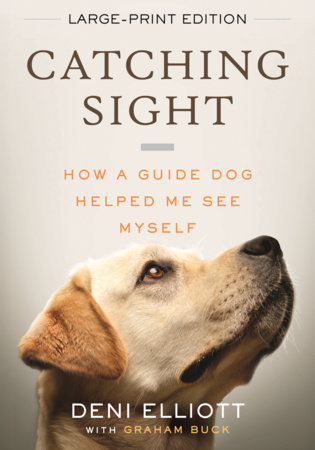
Catching Sight Discussion Questions1) Deni describes her parents and sister holding “their helpful hands behind their backs” so that she would become independent despite her low vision (Chapter 2). How is this style of raising a child with a known limitation helpful and how is it not?
2) As an adult, Deni wonders if she is being deceptive when she portrays herself as normally-sighted. When she was a child, her parents asked her “visual” questions like, “How do I look?’ that taught her to give deceptively specific answers like, “Nice tie,” or “I like the way your hair looks!” Were either Deni or her parents wrong in what they did? Does this count as deception?
3) When Deni goes to Guiding Eyes for the Blind to meet Alberta (Chapter 8), she is startled when her escort tells her where to touch the raised numbers on her bedroom door to learn her room number. Deni saw that the numbers were big and bold and black against the white door and said, “I have enough residual vision to read the numbers.” The staff member told her that at Guiding Eyes, staff, volunteers, and students are assumed to be totally blind and campus was designed on that premise. What differences do you expect between an environment that is visually-oriented and one that is not?
4) At Guiding Eyes, Deni learned the motto: “Trust Your Dog.” That means that if your guide dog does not do as you ask when you say “Forward,” or “Turn Right,” for example, the human partner is supposed to first follow the dog’s direction instead of insisting on their own, and then try to figure out why the dog made a different choice. What do you see as an argument for and an argument against following this motto?
5) As Deni learned to puzzle out her guide dog’s choice when the dog did something unexpected, she applied that analysis to how she related to people. Rather than guess what the person intended by an unusual remark, she learned to say, “Please say that in other words. I didn’t get it.” How apt do you find this analogy between dog-partner communication and human-human communication?
6) When Deni and her guide dog are out in public, Deni responds to people who want to pet her dog or who ask the dog’s name or if the dog is friendly by saying, “Please ignore the dog. She is working.” Is this an appropriate response? Why or why not?
7) One of Deni’s goals in writing Catching Sight is to give pet dog owners some ideas for improving their relationships with their own family dogs. In which ways do you think she achieved her goal and how didn’t she?
8) Have you had experiences of “interspecies communication” with a dog or with another non-human animal? What has that looked like for you?
9) “Accessibility” is one way that society includes people with diverse abilities. If a society is accessible, additional assistance is provided as an individual or group requires. Some college students get extended time to take a test or have a notetaker or sign-language interpreter in class. Braille users can type text on their computers with the help of special equipment. “Universal Design” is a different method of addressing diverse abilities. It starts with the principle of creating physical and online worlds from the ground up so that everyone has a choice of how to maneuver. Curb cuts and elevators are physical world examples of universal design; default settings in computer programs that include closed caption and audio descriptions of images are online examples. Do you think accessibility or universal design is a better approach and why?
10) A disclaimer at the front of the book includes the following: “The names and identifying characteristics of some individuals have been changed to protect their privacy, some events have been compressed for better narrative flow, and most dialogue has been recreated.” Is this disclaimer important? As memoirs purport to be true, at least from the storyteller’s point of view, is it acceptable for changes as described in the disclaimer to be made?