There are two regions in the United States designated as “Tornado Alley” due to their disproportionately high frequency of tornadoes. One is in Florida, but those tornadoes come out of tropical storm systems and tend to be weaker. The “Tornado Alley” most Americans are familiar with is found on the southern plains of the central United States, where supercell thunderstorms occasionally produce EF-5 level tornadoes with winds that can reach 200mph. The tornadoes that destroy everything in their unpredictable path.
No town in the country has endured the wrath of these wicked twisters like Moore, Oklahoma. In 1893, thirty-one people died, and more than a century later thirty-six perished in a 1999 tornado. On May 20, 2013, Moore was victimized again. This time twenty-five citizens were killed, including seven third-graders at Plaza Towers Elementary, which toppled over them as they prayed for survival.
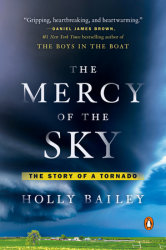
Holly Bailey returned home to write The Mercy of the Sky, an intense minute-by-minute account of the deadly 2013 tornado. The seasoned White House correspondent takes readers inside homes, schools, neighborhoods, and weather centers to tell the stories of being in the center of this brutal monster of a storm. Bailey’s book is devastating — loved ones are swallowed up by the funnel — but it also shows the great humanity of her hometown.
The Mercy of the Sky is both harrowing and hard to put down. Bailey talked to Penguin Random House about “grinder” tornadoes, Oklahoma as a meteorologist’s paradise, the resiliency of Moore, and Prince. Naturally.
PENGUIN RANDOM HOUSE: Let’s start with your most recent endeavors; you covered the Prince memorial in Minneapolis. What was that like and am I going to start weeping again?
HOLLY BAILEY: It was really powerful. I got to Minneapolis just as thousands of people were starting to gather outside First Avenue. It’s the nightclub where Prince performed early in his career and where he filmed pivotal Purple Rain scenes. The mood was somber, but people were also dancing and singing along to his greatest hits piped through giant speakers outside the club. The streets were so packed that you could barely move. All these thousands of people began to sing and sway along to “Purple Rain.” It was one of those moments that will stay with you. For Minneapolis, Prince was more than just this musical icon, he was a hometown son who never turned his back on where he was from. People there appreciated that about him.
PRH:You are also covering the Donald Trump campaign for Yahoo News, which must be a dream gig because he’s been the center of the political universe for months. On the other hand, journalists don’t seem so popular over there. Please give us the inside scoop on what your interactions with Trump and his followers have been like.
HB: This is my fourth presidential campaign, and I can say that I’ve never covered anything like the Donald Trump phenomenon. It’s too easy to say that it’s the celebrity driving his campaign. He has really struck a chord with people who like that he is not a typical politician and who see him as someone who can truly shake up Washington. For a reporter, he’s interesting because he doesn’t follow the script of a typical presidential candidate. There’s no regular stump speech. He’s somewhat unpredictable. But now he faces the pressure of whether this formula can work heading into the general election. It’s fascinating.
PRH:You’ve already had a remarkable career. Can you tell us how you went from Moore, Oklahoma to flying around the globe with Presidents Bush and Obama?
HB: I got started covering local politics for an Oklahoma City newspaper while I was still in college. I eventually ended up in Washington, where I landed a gig working for Newsweek, where I was the White House correspondent for many years.
PRH: What are the similarities and differences in covering events like war zones, Hurricane Katrina, etc., and coming back to report on the tragedies that befell the place you grew up?
HB: As a White House correspondent, I saw the firsthand impact of Hurricane Katrina when I flew to New Orleans with George W. Bush in the days after the storm. But nothing prepares you for covering a story of destruction like that in your own hometown, of seeing neighborhoods and landscapes you’d known your entire life just wiped out. It obviously added a much more emotional aspect to doing the job of covering the story.
PRH: Can you give us a sense of the size and scope of the May 20, 2013 tornado?
HB: It started off as just a wispy little funnel, but soon it became a massive tornado. At one point, it was more than a mile wide. To people in front of it, it just looked like this black wall of cloud coming straight for them. It was so big that cars lifted up by the storm looked like Hot Wheels being sucked up into the sky. The thing that always sticks with me is how the storm became what they call a “grinder.” It began to slow down and linger over neighborhoods, just chewing up everything in its path. In some neighborhoods, the storm was so strong it sucked all the grass from the ground.
PRH: How quickly did you return to Moore and at what point did you decide to write a book?
HB: I was in my office in New York when I saw television coverage of the tornado heading towards Moore. I was on the ground in Oklahoma the following morning. It was around that time that people began to ask the question — as they always do — about why Oklahomans choose to live in a place where weather can kill you. I found myself trying to explain the unique relationship Oklahomans have with the weather as well as the incredible ways meteorologists in the state cover storms. I also kept thinking of the resilience of the people of Moore, a city that has been through so much, and how they keep going in spite of Mother Nature’s wrath. I felt like it was a story that needed to be told — particularly in the lens of this storm, which was so horrific.
PRH:One misconception I had (even with a wife from Oklahoma), is that tornadoes are an annual weather event and everyone is used to dealing with the danger, but that isn’t exactly the case, is it?
HB: I think people do pay closer attention to the weather in Oklahoma than in other places, but this storm was unique because it hit earlier in the day. But at the same time, I think there was a perception among some local people that a tornado would never happen to them. One of the things I was surprised by was how few tornado shelters there were in Moore prior to the 2013 storm, especially because this was hardly the first major tornado to hit the city. I think that’s one thing that has definitely changed — there was a boom installing tornado shelters, especially in Moore.
PRH:It’s fascinating that Oklahoma is the epicenter of weather science; the source of inventions like Doppler radar, and one of the best places to be a meteorologist. How much did you know about this world before writing The Mercy of the Sky?
HB: I was incredibly aware of it. Growing up in Oklahoma, there’s an obsession with the weather in your blood. I constantly read books about the weather and considered all the television meteorologists to be total rock stars. I grew up wanting to be Gary England, who was the legendary KWTV weatherman. In fact, at Newsweek, I pitched a story on the local TV weather wars, but I was always too busy with campaigns and politics to do it. I’m glad to be able to tell the backstory of not only how TV weather coverage evolved, but also to sing the praises of these incredible meteorologists at the National Weather Service who do such an incredible job trying to keep Oklahomans safe.
PRH: The firsthand stories of those whose survived buildings and homes being ripped apart — especially the Plaza Towers Elementary teachers who laid on top of students to shield them from debris — are astounding. What was the interviewing process like and how hard was it for subjects to re-create the terror?
HB: Those were the toughest interviews because I wanted to write a book that would give people a real sense of what it was like to be in the path of a storm like that — what it looked and sounded like, how it smelled. But to really get into that, I had to ask the survivors to relive this horrible moment where many thought they were going to die. I felt terrible about it because they had already been through so much. We’re talking about teachers who still feel anxious when the wind picks up or they hear the weekly testing of the tornado sirens. Many feel some guilt about surviving when so many others did not.
One thing I am incredibly proud of is being able to tell the stories of all of these amazing people who were pillars of strength in moments when many people would simply fold. To me, Amy Simpson, who was the principal of Plaza Towers, is one of the most incredible women I have ever met. We had many tearful conversations, but I’m so grateful that she talked to me and that I was able to tell her story. For years to come, people will know how amazing she is.
PRH: How is Moore faring today?
HB: The incredible thing about Moore is its resilience. But they have also been through so many tornadoes that they are professionals when it comes to dealing with disaster. They began picking up debris just days after the storm, and many neighborhoods were cleared of rubble within a couple of months. That’s incredible when you consider there are parts of New Orleans where you can still see houses wrecked out by Hurricane Katrina or along the New Jersey coastline, where Superstorm Sandy hit. Three years later, many of the neighborhoods in Moore are rebuilt, and you’d never know a tornado tore them apart. However, people in Moore live knowing they will very likely be hit again by another tornado. They are resolved to that fate of being the “tornado alley of tornado alley,” as some have put it.
PRH: Did writing The Mercy of the Sky change the way you feel about your hometown in any way?
HB: I knew Oklahomans were strong, but I didn’t truly gauge the depth until I began writing. I also think the book is a testament to how incredible meteorologists are when it comes to saving people’s lives. Twenty-five people died in this storm, but it could have been so much worse.