




Nicola Morgan
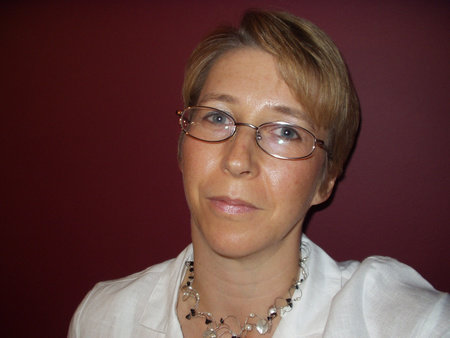
Photo: © courtesy of the author
"I like what I call ‘books with soul’. . . . books which grab me emotionally and do more than tell a story."–Nicola Morgan
Nicola Morgan lives in Edinburgh, Scotland, and has written over 50 nonfiction children’s books. She is the author of the novels Mondays Are Red and Fleshmarket.
ABOUT THE AUTHOR
My Odd Childhood
The oddness of my childhood began on 11th November 1961, the day I was born – in a school. My parents lived in the school and presumably thought it was a perfectly sensible place to have a baby. We moved several times in my childhood – always to schools. My father was a headmaster. In fact, he was my headmaster, teaching me English and French while my mother taught maths and science. All that is odd enough, but what was odder was that they were boys’ schools and I am, I assure you, not a boy.
It was a childhood of huge freedom. The schools were in the country, so in the holidays my sisters and I had free run of amazing facilities and endless countryside. I spent my days climbing trees, building rafts, making bows and arrows, and riding my pony in the woods where Mondays are Red is set.
At 11, I went to a girls’ boarding school. Strangely, no-one there was at all impressed by my tree-climbing or weapon-making skills.
University
I did Classics and Philosophy at Cambridge. Philosophy was the best bit – endless discussions about meanings, and meanings of meanings.
Work
It was all very well being trained to discuss meanings of meanings but exactly how was it going to earn me a living? I desperately wanted to write but I also knew I had to have a ‘proper job’ to tide me through the rejection letters.
I became a teacher. I taught English in such a small school that I was the whole English department. This school led me into the world of children with reading difficulties like dyslexia. I did a Diploma in teaching people with reading and writing problems, and when my daughters were young I was able to combine motherhood with teaching from home.
Through this work, I became interested in how all children learn to read and in 1994 I set up Magic Readers™. Groups of pre-school children came to my house to have fun with all sorts of pre-reading activities. I wanted to create happy, confident and excited readers, at the same time as showing parents how to help their own children.
By 1999, I’d had quite a few home-learning books published and my writing was taking over. Soon I stopped teaching altogether. Magic Readers™ became a website, The Child Literacy Centre™
I still run that site. I receive many emails from parents who need advice about helping their own children and I answer every one personally.
Small FAQs:
Q: What’s your favourite food?
A: Anchovies, haggis, pickled onions, the stinkiest blue cheese and horse-radish.
Q: Where do you live?
A: Near Edinburgh, surrounded by woods.
Q: Do you have any hobbies?
A: Reading, cooking, glass-painting, making mosaics, talking …
Q: What do you hate doing?
A: Gardening. The trouble is, I love sitting in a beautifully-kept garden.
Q: Do you have a pet?
A: Until recently we had 3 cats, but now there’s just the dog. No, the dog didn’t eat the cats – I don’t think.
The dog is a yellow labrador called Amber, a gorgeous nuisance. I gave her an important part in Mondays are Red.
Q: Computer or pen?
A: What’s a pen? Definitely computer. If I wrote with a pen I wouldn’t be able to play frequent games of spider solitaire, would I? Also, I change too many things too often, so it would destroy several forests if I used paper.
Q: What is your idea of heaven?
A: Lying in a hammock under a shady tree on a scorching day, sipping something chilled and fizzy, after hearing that my next novel has been accepted by my publisher.
Q: And hell?
A: Gardening, in the rain, in February, in Scotland, after receiving an email from my editor to say that the text for my new novel is rubbish and I’ll have to start again.
**********************************************************
Q: Did you like writing at school?
A: I loved it. I loved everything about English – even grammar. In fact that was one of my favourite bits. I felt that understanding how the bricks of language fit together perfectly and strongly would help me build powerful writing. For me, learning Latin and Greek was crucial to this. Now, I often break the rules, but I do it for a reason.
Oddly, I never actually wrote a story until I was 14. Instead, I always turned every writing task into a description or poem. I remember that story though – it was called The Hostage and was in my first public exam. I do NOT recommend using an exam to try out a new style….
I wrote lots of poetry, too – horribly gloomy stuff. Once, my teacher was so worried that she threatened to contact my parents unless I stopped sounding so depressed. But I’ve always written about things I imagine, more than things I experience. That’s the whole point about imagination.
Q: What do you like about writing fiction as opposed to non-fiction?
A: It uses an entirely different part of my brain. It is freeing and exciting. I love the power of words, the sounds they make and the different pictures they conjure. When I write, I am playing with words, and I always read my work aloud so I can hear it, too. The sound and rhythm of words are very important to me. When the sound, rhythm and meaning blend perfectly, that’s when language becomes music. I’m not saying I achieve that, just that I try.
Q: Did you always want to write for younger people?
A: I write for anyone who will read it – I don’t care how old you are! (And actually, I HATE age-categories – they are there to help booksellers, not readers or writers). But, no – my fiction used to be for adults and I remember the moment when I changed: on holiday in Crete, my whole family read David Almond’s Skellig and it completely altered my perception of what books for younger people could do. My daughters were about 10 and 8, so it seemed the perfect inspiration to move over to writing for younger people. Young imaginations are more free, somehow, and authors have a wonderful chance to stretch their own imaginations and simply make the words fly.
In a way, writing for young people is harder. You can’t get away with endless pages of self-indulgent waffle. Young people only bother to finish the book if it’s more powerful than football, or computers, or TV.
Q: Do you have an agent?
A: Yes, thank goodness. I didn’t for a long time, but she came on board after seeing the first draft of Mondays are Red. She does all the things I hate – working out contracts and making sure I get the best possible deal from publishers. When I have a new idea, I discuss it with her first and she gives me an honest and expert opinion.
Q: What books do you like reading?
A: I usually only enjoy very modern fiction. Nineteenth century fiction does nothing for me, although I did have my Thomas Hardy phase. From the mid-twentieth century, I loved The Gormenghast Trilogy, Lord of the Flies and The Lord of the Rings. But you really have to go to the very end of the 20th century and the beginning of the 21st to find the authors I most enjoy. I read a lot of "teenage" books, because so much of it is brilliantly written – more adults should give it a try.
I like what I call ‘books with soul’. David Almond and Julie Bertagna write books with soul: books which grab me emotionally and do more than tell a story. Another big favourite is Robert Cormier. I have also just read and loved The Moth Diaries by Rachel Klein. My favourite "adult" books are The Countrywoman by Paul Smith, Atonement by Ian McEwan, The Blind Assassin by Margaret Atwood, Drowning Ruth by Christina Schwartz and anything at all by Bernice Rubens.
For more, visit www.nicolamorgan.co.uk


