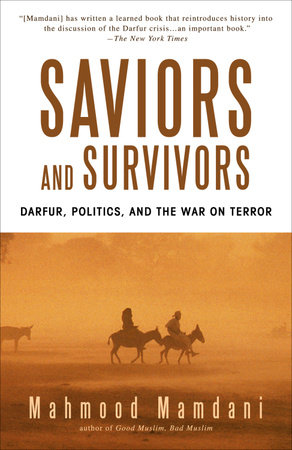
“Mahmood Mamdani . . . is one of the most penetrating analysts of African affairs. In Saviors and Survivors: Darfur, Politics, and the War on Terror, he has written a learned book that reintroduces history into the discussion of the Darfur crisis and questions the logic and even the good faith of those who seek to place it at the pinnacle of Africa’s recent troubles . . . [An] important book.”—Howard W. French, The New York Times
“Say ‘Darfur’ and horrific images leap to mind: Janjaweed, rape, genocide. But most of us would be hard-pressed to explain the violence there, beyond the popular notion that it’s ethnic cleansing of Africans by Arabs. . . . Saviors and Survivors explains why this assumption is faulty, and why it’s foiling peace efforts.”—Newsweek
“[Mamdani] demonstrates just how politically charged the word ‘genocide’ has become, and how many shady agendas it can serve, even among those purporting to act in the name of universal values . . . His extensively documented study of the political and media circus that came to surround the hitherto uncelebrated province of Darfur is a vivid demonstration of the predictably calamitous results of outsiders meddling in places whose history, politics, and culture they can hardly be bothered to read up on.”—Harper’s Magazine
“Very few books on the Darfur crisis have provided such a good analysis of what is happening in the region and very few voices have attempted to understand the crisis in its local, regional, and international context. Very few books have attempted to discuss the crisis in its historical and geopolitical context. In reality discovering such an insightful book is like finding a needle in the sea.”—Al-Quds al-Arabi (London)
“Hidden in the middle of Saviors and Survivors’ controversial thesis critiquing international interventionism is Mamdani’s scholarly genius. The book scrutinizes, critically analyzes, deconstructs and reconstructs the deep historical transformations that constitute the underbelly of the continent’s post-colonial citizenship structures.”—African Affairs (London)
“Mamdani’s book is by far the most exhaustive study of the conflict and is carried out with an impressive display of investigative prowess and referencing . . . This study is reassuring in its learned dependence on a great variety of sources and an admirable depth of research. Indeed, the reader will discover that Darfur is not quite the mysterious and unknown place that we have tended to imagine . . . It is to be hoped that this book is widely read and debated.”—John C. Caldwell, Population and Development Review
“[A] sweeping history of Darfur . . . Provide[s] valuable historical and cultural background to recent events in Darfur and the sure-to-continue scholarly debate on genocide.”—Library Journal
“Mamdani traces the path to the Darfur tragedy through its historical and colonial roots to the current situation. His radical reevaluation of the Darfur problem is a major contribution to understanding and, it is to be hoped, to ending a shocking human disaster.”—Sir Brian Urquhart, former Under-Secretary-General of the United Nations
“An incisive and challenging analysis. Framing both Darfur’s war and the ‘Save Darfur’ movement within the paradigm of the West’s historic colonial encounter with Africa, Mahmood Mamdani challenges the reader to reconsider whether Darfur’s crisis is ‘genocide’ warranting foreign military intervention.”—Alex de Waal, Fellow at Harvard University’s Kennedy School of Government and author of War in Darfur







 QUICK VIEW