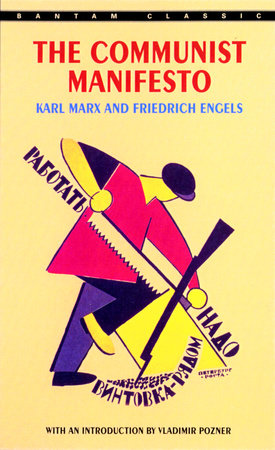
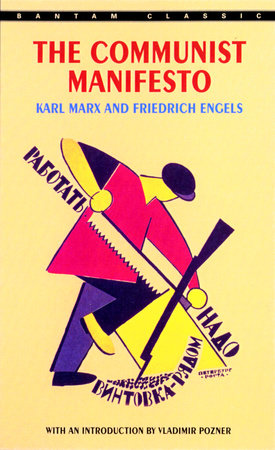
Karl Marx’s groundbreaking work that calls for the overthrow of capitalism in favor of a classless society free of exploitation and inequality.
“No man has influenced the course of human history in the nineteenth and twentieth centuries more than Karl Marx. . . . The Communist Manifesto reads today with no less vibrancy and urgency than in 1848.”—Vladimir Pozner, from the Introduction
“A spectre is haunting Europe—the spectre of Communism.”
So begins one of history’s most important documents, a work of such magnitude that it has forever changed not only the scope of world politics, but indeed the course of human civilization. The Communist Manifesto was written in Friedrich Engels’s clear, striking prose and declared the earth-shaking ideas of Karl Marx. Upon publication in 1848, it quickly became the credo of the poor and oppressed who longed for a society “in which the free development of each is the condition for the free development of all.”
The Communist Manifesto contains the seeds of Marx’s more comprehensive philosophy, which continues to inspire influential economic, political, social, and literary theories. But the Manifesto is most valuable as a historical document, one that led to the greatest political upheavals of the nineteenth and twentieth centuries and to the establishment of the Communist governments that until recently ruled half the globe.
This Bantam Classics edition of The Communist Manifesto includes an introduction by Vladimir Pozner, Marx and Engels’s historic 1872 and 1882 prefaces, and Engels’s notes and prefaces to the 1883 and 1888 editions.