Best Seller
Paperback
$18.95
Published on Sep 01, 2015 | 144 Pages
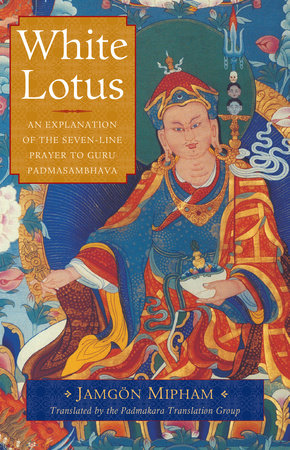
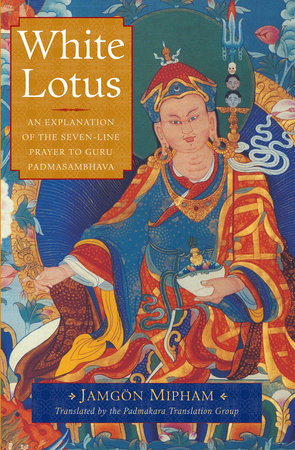
The commentary translated in these pages is unusual and rare. But if the commentary is a rarity, its subject matter—the seven-line invocation of Padmasambhava—is one of the best-known prayers in the Tibetan Buddhist world.
The overall significance of the Seven-Line Prayer is perhaps best appreciated in relation to a practice called guru-yoga, or “union with the nature of the guru.” The purpose of guru-yoga is to purify and deepen the student’s relationship with his or her teacher. It is introduced as one of the preliminary practices, and it remains crucial—in fact, its importance increases—as one progresses through the more advanced levels of the tantric path. The cultivation of devotion to the guru and the blending of one’s mind with his or her enlightened mind is, in the words of Dilgo Khyentse Rinpoche, “the most vital and necessary of all practices and is in itself the surest and fastest way to reach the goal of enlightenment.”
Regarding the origin of this commentary, Mipham refers in the colophon to an event that triggered the abrupt appearance in his mind of the hidden meaning of the prayer. It is interesting to note that the language Mipham uses suggests that the commentary itself is not an ordinary composition but perhaps a treasure teaching, specifically a “mind-treasure” or gongter.
The overall significance of the Seven-Line Prayer is perhaps best appreciated in relation to a practice called guru-yoga, or “union with the nature of the guru.” The purpose of guru-yoga is to purify and deepen the student’s relationship with his or her teacher. It is introduced as one of the preliminary practices, and it remains crucial—in fact, its importance increases—as one progresses through the more advanced levels of the tantric path. The cultivation of devotion to the guru and the blending of one’s mind with his or her enlightened mind is, in the words of Dilgo Khyentse Rinpoche, “the most vital and necessary of all practices and is in itself the surest and fastest way to reach the goal of enlightenment.”
Regarding the origin of this commentary, Mipham refers in the colophon to an event that triggered the abrupt appearance in his mind of the hidden meaning of the prayer. It is interesting to note that the language Mipham uses suggests that the commentary itself is not an ordinary composition but perhaps a treasure teaching, specifically a “mind-treasure” or gongter.
Author
Jamgon Mipham
Jamgon Mipham (1846–1912), one of the great luminaries of Tibetan Buddhism in modern times, has had a dominant and vitalizing influence on the Nyingma School and beyond. He was an important member of the Rimé, or nonsectarian movement, which did much to strengthen and preserve the entire tradition. A scholar of outstanding brilliance and versatility, his translated works are eagerly anticipated by English-language readers.
Learn More about Jamgon MiphamYou May Also Like
Mother Emanuel
Trade Paperback
$23.00
When Heroes Fall
Trade Paperback Original
$19.00
The Buddha Way
Hardcover
$6.99
Stoic Secrets
Hardcover
$6.99
My Gentle Angel Michael
Trade Paperback
$6.99
My Gentle Angel Raphael
Trade Paperback
$6.99
My Gentle Angel Gabriel
Trade Paperback
$6.99
The Friendship Devotional
Hardcover
$18.00
Jesus Will Meet You There
Hardcover
$25.00
×