A Conversation with Bruce Murkoff
Q: How did you come to write the novel?
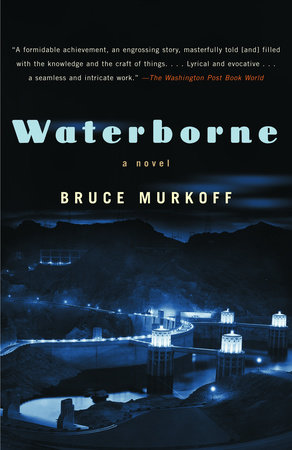
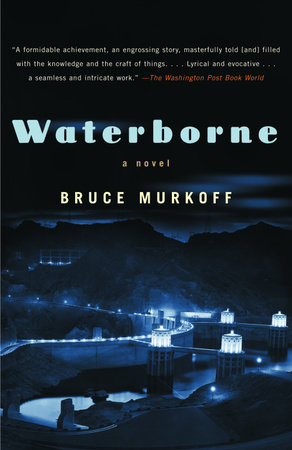
A: The genesis of Waterborne was a visit to the Hoover Dam in 1995. I’d never had any particular interest in dams, but my wife had been there several times and insisted that I see it because it made her appreciate men (a long, separate story), which I understood at first glance. Seeing the dam, you get a vision of the people who made it—what it must have taken to build this thing in the middle of that desert. I began to read about it, to see it in the context of the period, and the novel began to take shape, but only in my mind.
A year later, Suzanne and I drove up to San Francisco, where she had a meeting at her gallery. I dropped her off on Geary Street and drove off in search of a parking space. We had a Suburban at the time, and parking was always a challenge. My wife stood in the rain on the street in front of the gallery for an hour, listening to the police sirens and watching ambulances race by—wondering if I was in the back of one. She made a deal with God that if I showed up unscathed, she would support me while I wrote. When I finally ambled around the corner, she cried in relief and told me the plan. By the time we got back to the ranch in Lampoc, she had convinced me to sever ties with Hollywood and write the Hoover Dam novel that I had been thinking about. She kept her promise, and even though it took me six years to finish, we are still happily married and living on a small farm in the Hudson Valley in New York.
Q: Can you explain the title?
A: Waterborne is a reference to the property of water that allows it to carry both objects and metaphor.
Q: Has the time period of the Great Depression always held a particular interest to you as writer?
A: I did not have a particular interest in the period, but the period became very interesting to me as the context of the characters lives and dreams.
The dam is, in a way, born out of these people, and thus, out of what they were born into. This gave me the blueprint. Mentally, I first saw them there, at the dam. Even today, it is easy to visualize these people because the town built for the dam-makers exists very much intact. But in order to understand why they were there, I had to envision where they had come from. From there I had the pleasure of writing each journey.
Q: How did you go about creating characters for your novel Waterborne? Were they at all inspired by people in your own life or in history?
A: I started with the engineer. The thought process and organizational methods of the engineer are completely antithetical to my own, and that’s why I find them so interesting. A person whose mind is oriented towards reason following fact has got to have difficulty with the less rational emotional response to life-changing events. To have this character at the center of the story allowed me to play all the other characters off his stoicism, and express a more natural fluidity.
The principal character, Filius Poe, is loosely based on characteristics shared by my wife and a very good friend, now deceased, who was a geothermal engineer. They share a common interest in analytical problem solving and the way things work. Furthermore, my friend, Ben Holt, had been to the dam during its construction in the 1930’s, and shared his memories and photographs.
Lena, Addie, Fanny and Cece are deconstructions of all the things I like in women.
By this I mean I wanted four distinct personalities. They are all appealing to me: Addie because she is book-smart and beautiful—a natural first love for Filius, Lena because she is warm, loving and full of learned lessons , Fanny because she is boisterous and playful, and Cece because she is sexy, funny, and despite the nature of her work, loyal.
As far as Lew Beck is concerned, he stepped out of the darkness and refused to leave.
I had been writing about essentially good characters, and my own nature needed a balance to all that goodness. Lew is the antithesis of Filius. Filius is the equivalent of a Mayflower American; Lew is a man whose parents were un-assimilated immigrants. His “otherness” is emphasized both by his lack of physical stature and apparent irrationality. Without that seething irrationality, violence would not have become his signature.
The other characters who are met in the travels or at the dam, are figments developed out of research. The Prager character for instance, came about after I saw on old photograph of a family car rigged with a smokestack so they could cook as the traveled west during the Depression. I situated him in Kearney, which turned out to have had a large German population which was persecuted by the National Security league after World War One.
Q: How long did it take to write the book?
A: About six years. I tried to write every day (usually resulting in a paragraph a day, but I’m a little faster now after six years of practice), and found that my best time was in the morning and in those last few hours of the day before the cocktail hour.
Q: You have spent much time on the West Coast but now live in New York. Do you think your next writing project and/or novel will be influenced by that?
A: The book I’m working on now has its genesis in another river and another century, so yes, geography and location are influential.







 QUICK VIEW