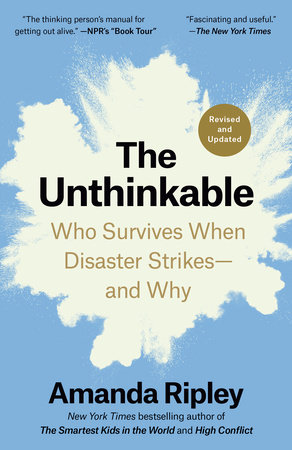
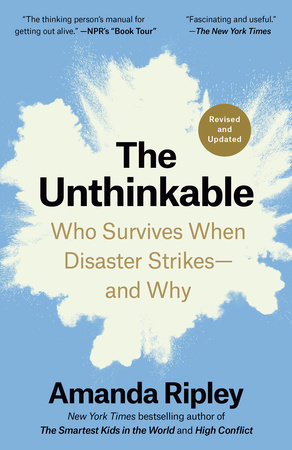
“Fascinating and useful.”—The New York Times
“A must read. We need books like this to help us understand the world in which we live.”—Nassim Nicholas Taleb, author The Black Swan and Fooled by Randomness
“Engrossing and lucid . . . facing the truth about the human capacity for risk and disaster turns out to be a lot less scary than staying in the dark.”—O: The Oprah Magazine
“The Unthinkable isn’t merely a book about disaster; it’s a book about survival—maybe yours.”—Gavin de Becker, author of The Gift of Fear
“Ripley is a voyeur on a mission. . . . Her conviction: We’d all stand a better chance of surviving a disaster if we understood what happens to our little gray cells when things get ugly. . . . Spiced with surprising factoids, this book might save your life one day.”—Bloomberg News
“This is a book with a purpose, meant to change things.”—Rob Hardy, The Commercial Dispatch
“These tales leave your viscera enflamed because they compel two questions: ‘What would it feel like to go through that?’ and ‘Would I do the right thing and survive?’ This is an irresistible book.”—Robert M. Sapolsky, author of Determined
“The Unthinkable is the most magnificent account of a survivor’s mind that I have ever read. It has helped me know and accept some of my reactions during my seventy-two-day ordeal in the Andes. I can now understand how fear motivated me, and how denial also played a part. This book will help those who’ve never faced disaster to understand their own behavior and be prepared should their luck run out one day.”—Nando Parrado, author of Miracle in the Andes
“The Unthinkable reveals why, under the same circumstances, some people caught up in a disaster survive and others do not. In her well-crafted prose, Amanda Ripley shows us all how to prepare to meet danger and increase our chances of surviving the unthinkable.”—Bruce Henderson, author of Down to the Sea and True North
“When a disaster occurs we invariably learn the ‘what’ of the event—how many died, how many survived. Amanda Ripley’s riveting The Unthinkable provides genuine insight into the ‘why’ behind the numbers. This remarkable book will not only change your life, it could very well save it.”—Gregg Olsen, author of The Deep Dark: Disaster and Redemption in America’s Richest Silver Mine
“Ever fantasize about what you would do in a disaster? How would you survive? How would you behave? After interviewing survivors of the World Trade Center attack, Amanda Ripley sifted through amazing tales of survivors from other disasters and mined various sociological, psychological, and neurological studies. Her insights are absolutely fascinating, and they could come in handy one day.”—Walter Isaacson, author of Elon Musk





 QUICK VIEW