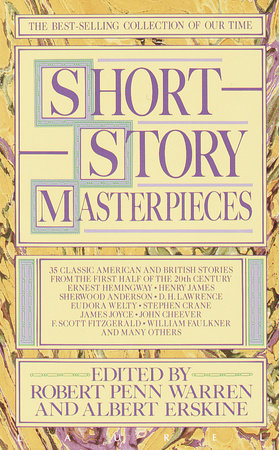
Short stories can be funny, pathetic, frightening, uplifting, nostalgic, beautiful—and it is just this variety that makes them the popular and satisfying reading they are. Here are thirty-five of the best stories by British and American writers in the first half of the twentieth century, in an outstanding anthology that ranges in kind from the humor of James Thurber and Ring Lardner to the irony of Ernest Hemingway and James Joyce.
Each story is different from every other—but each bears the stamp of unmistakable greatness, including:
• “The Bride Comes to Yellow Sky” by Stephen Crane
• “The Horse Dealer’s Daughter” by D. H. Lawrence
• “Barn Burning” by William Faulkner
• “The Sojourner” by Carson McCullers
• “The Open Window” by Saki
• “Flowering Judas” by Katherine Anne Porter
• “The Boarding House” by James Joyce
• “Soldier’s Home” by Ernest Hemingway
• “The Tree of Knowledge” by Henry James
• “Why I Live at the P.O.” by Eudora Welty
Editors Robert Penn Warren and Albert Erskine selected stories that broke new ground and challenged the imagination with their style, subject matter, or tone: the unforgettable, enduring works that shaped the literature of our time.
Author
Ernest Hemingway
Ernest Hemingway (1899–1961) was born in Illinois and began his career as a reporter before enlisting as an ambulance driver at the Italian front in World War I. Hemingway and his first (of four) wives lived in Paris in the 1920s, as part of the “Lost Generation” expatriate community, before moving to Key West, Florida, and later to Cuba. Known first for short stories, he sealed his literary reputation with his novels, including The Sun Also Rises, A Farewell to Arms, For Whom the Bell Tolls, and The Old Man and the Sea.
Learn More about Ernest HemingwayAuthor
William Faulkner
William Faulkner, one of the greatest writers of the twentieth century, was born in New Albany, Mississippi, on September 25, 1897. He published his first book, The Marble Faun, in 1924, but it is as a literary chronicler of life in the Deep South—particularly in the fictional Yoknapatawpha County, the setting for several of his novels—that he is most highly regarded. In such novels as The Sound and the Fury, As I Lay Dying, Light in August, and Absalom, Absalom! he explored the full range of post–Civil War Southern life, focusing both on the personal histories of his characters and on the moral uncertainties of an increasingly dissolute society. In combining the use of symbolism with a stream-of-consciousness technique, he created a new approach to fiction writing. In 1949 he was awarded the Nobel Prize for Literature. William Faulkner died in Byhalia, Mississippi, on July 6, 1962.
Learn More about William Faulkner