A Conversation with Brenda Wineapple
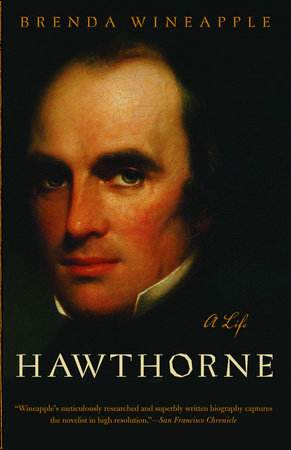
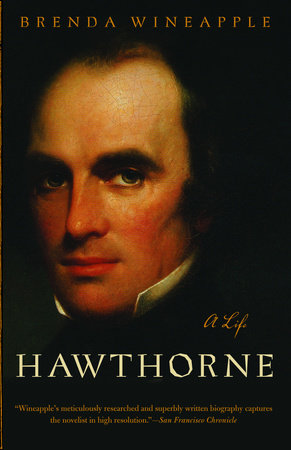
Q: Next year is the 200th anniversary of Hawthorne’s birth. What does he have to tell us in the 21st century?
A: We live today in a world rife with terrorism driven by religious fanaticism, and no one conveys better than Hawthorne how religion or ideology can induce hysteria, violence, and cruelty. He wrote scathingly of the witchcraft delusion that possessed the men and women of Salem and turned them into the persecutors and rank murderers of their neighbors. Fanaticism, whether of his Puritan ancestors or of the abolitionists, was repugnant to Hawthorne. And no one has more than Hawthorne to tell us, too, about the flip side of fanaticism—self-doubt, guilt, self-hatred.
Q: Hawthorne is one of America’s best-known writers. What was your biggest surprise in writing about him?
A: I was most surprised at his politics—in particular his nefarious views about slavery, since they have largely been papered over or ignored. Here was a man of great moral sensibility who came of age in the era that produced a bumper crop of political idealists: Frederick Douglass, Abraham Lincoln, Harriet Beecher Stowe, Henry David Thoreau, Emerson, Margaret Fuller, Sojourner Truth, William Lloyd Garrison, Horace Greeley, Walt Whitman. Yet, Hawthorne’s strongest political enthusiasm was for Franklin Pierce, arguably one of this country’s worst presidents. Pierce, who occupied the White House from 1853 to 1857, was America’s Pétain, seemingly blind to the evils of slavery both before and during the Civil War.
Perhaps naively, we assume that because our great writers have a capacious view of humankind, they vote the same way we do. But some of our most admired literary figures had abominable politics—Gertrude Stein and Ezra Pound, to name just two. And so it was with Hawthorne on the matter of slavery: we’re shocked not only by his views but that he stood almost by himself in opposition to his literary peers.
If there is one thing to be said in favor of Hawthorne’s overt racism, as distinguished from the more covert racism of his anti-slavery friends, it is that he was genuinely worried what would happen to the slaves after emancipation in a country as racist as ours. Given the history of race relations in the century following the Civil War, that concern was prescient.
Q: In The Scarlet Letter Hawthorne created perhaps the most celebrated heroine in American literature, Hester Prynne. On whom was she modeled, and what accounts for the powerful impact she has had?
A: Of all the canonical American authors of the mid-nineteenth century, only Hawthorne created memorable women characters, and certainly his supreme achievement was Hester Prynne. A number of his friends and relatives contributed to Hester, prominent among them the feminist Margaret Fuller, Hawthorne’s mother and younger sister, and his rabble-rousing sister-in-law Elizabeth Peabody. But most of all Hester is Hawthorne himself. He says as much in the essay that introduces The Scarlet Letter, when he tells of trying on the scarlet letter, which burns his chest. He drops it quickly to the floor. In other words, Hawthorne identifies with Hester as an outcast brought low by a society she both respects and reviles. Hawthorne felt the same way, especially after he was fired ignominiously from his post at the Salem custom house just before he wrote the novel. For a man who lived much of his life in poverty, that was a cruel blow, and the pain and alienation he felt accounts to some degree for the power of the book.
Q: Hawthorne’s novels and stories have not lacked for admirers. But are there any that strike you as particularly ripe for rediscovery?
A: My prime candidate would be an essay, “Chiefly About War Matters,” published in The Atlantic in 1862. It summarizes Hawthorne’s tangled political views in a style reminiscent of Jonathan Swift and in some ways anticipates the playful and self-satirical wit of the new journalism of the 1970s, more than a century later. Had Hawthorne lived past 59, I believe he would have forged a new genre commensurate with the changing America he inherited.
Q: Hawthorne was a notoriously private, shy, even anti-social, figure. Did that present a special challenge in writing this biography?
A: That’s the myth of Hawthorne, not the reality. Hawthorne may have been reticent, but the women around him weren’t, and Hawthorne wrote about himself, his friends, his passions, constantly—in letters, in journals, and most of all, in his novels. “He always puts himself in his books,” said his sister-in-law Mary Mann. "He cannot help it." The impression of Hawthorne as a withdrawn figure may largely reflect the fact that he simply didn’t like many of his literary peers.
Q: Your first biography was of the New Yorker correspondent Janet Flanner and your second of Gertrude and Leo Stein. What led you to a writer as different from them as Hawthorne?
A: After writing about two unusual women, it seemed time to write about a canonical male. Few women have, and as a result, most biographies of the white males of the 19th century are largely devoid of women. As the first female biographer of Hawthorne, I confront the only major nineteenth-century American author before Henry James to make women the central figures of his novel and to write about illicit love, marriage, motherhood, women’s rights, and spiritualism.
In a sense, too, this book was a homecoming for me. I was born in Boston and have spent most of my life in New England. Essex County, Massachusetts, where I grew up, has changed from Hawthorne’s time, but not all that much: I know the streets Hawthorne rambled, the salt air he breathed, the hills he climbed and the green, quiet woods. Like him, I know the Commons, the churches, the color of the flinty sky during long New England winters. Those bright New England falls, harsh east winds, gracious homes, widow walks, and decayed wharves are part of our common birthright.







 QUICK VIEW