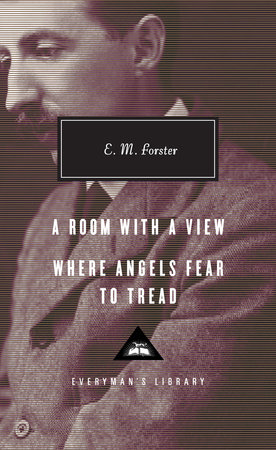
Forster’s most memorably romantic exploration of the liberating effects of Italy on the English, A Room with a View follows the carefully chaperoned Lucy Honeychurch to Florence. There she meets the unconventional George Emerson and finds herself inspired by his refreshingly free spirit— which puts her in mind of “a room with a view”—to escape the claustrophobic snobbery of her guardians back in England.
The wicked tragicomedy Where Angels Fear to Tread chronicles a young English widow’s trip to Italy and its messy aftermath. When Lilia Herriton impulsively marries a penniless Italian and then dies in childbirth, her first husband’s family sets out to rescue the child from his “uncivilized” surroundings. But in ways that they can’t possibly imagine, their narrow preconceptions will be upended by the rich and varied charms of Forster’s cherished Italy.
Everyman’s Library pursues the highest production standards, printing on acid-free cream-colored paper, with full-cloth cases with two-color foil stamping, decorative endpapers, silk ribbon markers, European-style half-round spines, and a full-color illustrated jacket. Contemporary Classics include an introduction, a select bibliography, and a chronology of the author’s life and times.
Author
E.M. Forster
Edward Morgan Forster was born on January 1, 1879, in London and was raised from infancy by his mother and paternal aunts after his father’s death. Forster’s boyhood experiences at the Tonbridge School, Kent, were an unpleasant contrast to the happiness he found at home, and his suffering left him with an abiding dislike of the English public school system. At King’s College, Cambridge, however, he was able to pursue freely his varied interests in philosophy, literature, and Mediterranean civilization, and he soon determined to devote his life to writing. His first two novels, Where Angels Fear to Tread (1905) and The Longest Journey (1907), were both poorly received, and it was not until the publication of Howards End, in 1910, that Forster achieved his first major success as a novelist, with the work many considered his finest creation. Forster first visited India during 1912 and 1913, and after three years as a noncombatant in Alexandria, Egypt, during World War I and several years in England, he returned for an extended visit in 1921. From those experiences came his most celebrated novel, A Passage to India, his darkest and most probing work and perhaps the best novel about India written by a foreigner. As a man of letters, Forster was honored during and after World War II for his resistance to any and all forms of tyranny and totalitarianism, and King’s College awarded him a permanent fellowship in 1949. He spent his later years at Cambridge writing and teaching, and died in Coventry, England, on June 7, 1970. His novel, Maurice, written several decades earlier, was published posthumously in 1971.
Learn More about E.M. Forster