Q: Before you started writing about food, you considered yourself a “foodie” but not a “food professional”. With no prior experience judging restaurants publically, was taking Craig Claiborne’s job as food editor of the New York Times a scary transition for you?
A: It was terrifying. I took the job knowing that I had no formal qualifications, but I couldn’t refuse. Because I also knew that I would kick myself for the rest of my life for backing off from such an opportunity to write about things I loved.
Q: You’ve had a New Yorker cartoon written about you! What are some other highlights from your career?
A: I was the first English-speaking journalist to write about the nouvelle cuisine of French chefs Paul Bocuse and Michel Guérard. That was in the early 70s. Since then, I’ve traveled to every continent, eating in just about all the historically pivotal restaurants, most recently at Noma in Copenhagen.
As a columnist for Natural History magazine, I hunted down surviving examples of vanishing traditional American foods and helped spark a national movement of interest in these heritage plants and recipes, which has preserved them and made them a part of our national foodways once again.
Q: You mention that in the early 1970’s Mexican ingredients were only available at one specialty store in New York City. Is it striking to you how much times have changed, forty years later?
A: Yes, it is simply astounding how much richer the food world in this country has become. Obviously, the restaurant scene in major cities is a hundred times livelier than it was in 1965. Native-born chefs preside over original menus not only on both coasts, but all over the heartland, too, in places I explored from 2006 to 2010 for the Wall Street Journal. Even supermarkets have been transformed. In the upstate Hudson-Valley community where I live, you can choose from dozens of specialty vinegars, aisles loaded with ethnic foods, first rate bread baked in the store, and the list goes on.
Q: What are some highs and lows of a career in writing about food?
A: On the high side, I’ve known some of the world’s great cooks—Thomas Keller of the French Laundry and Per Se, Heston Blumenthal of The Fat Duck near London, Charlie Trotter in Chicago. I’ve traveled from South America to Macao.
On the low side, the low-comic side, really, I’ve eaten some pretty terrible meals at places I was reviewing, places with big reputations and snooty reservationists, where famous guests got treated brilliantly and the rest of us (I used pseudonyms) got put in back rooms and never got the special dishes cooked only for celebrities. Once, a waiter brought me an omelet with a cockroach on it.
Q: You say one of the reasons you took the New York Times job was “to give Lutèce its rightful fourth star”. Food writers can really make or break a restaurant! How does that feel?
A: Very few restaurants deserve to be crushed. Even the worst chefs are not committing crimes, except against culinary taste. So I quickly saw that, while it was necessary to pan the occasional restaurant with an inflated reputation, to protect the public, the real thrill was to praise a talented cook and help her or him succeed. Being able to find talent and explain why I admired it, with persuasive, clear arguments, was what I liked best about my career in food. That and tasting a dish for the first time. I remember, vividly, the first fresh black truffle I tasted, at Point in Vienne. On a less lofty level, I put a plain looking pastry in my mouth in a workman’s bar in Cartagena on Colombia’s national day. Sweet and unctuous, it was a local specialty made from cassava (yuca), called enyucado.
Q: You’ve written about everything from cannibalism to dog food—what is your favorite piece you’ve ever written?
A: I will never forget the morning I spent with the world’s most admired chef, Joël Robuchon, in the kitchen of his 3-star restaurant in Las Vegas, when he developed an intricate dish for a new menu. Witnessing how his mind worked, in tandem with a bevy of ingredients—crab, sea urchin—to create something that was new and delicious—that was a wonderful thing to write about.
Q: Where is your favorite place to dine in New York City? In the country?
A: Restaurant Joël Robuchon at the MGM Grand in Las Vegas is probably the outstanding grande-luxe place to eat in North America. But there are dozens of other fabulous, stratospheric dining rooms from coast to coast. And not all of them serve fancy food or even have tablecloths. In Vegas, in a nondescript mall, is my favorite Thai restaurant, The Lotus of Siam. Thoroughly remarkable food and a world-class German wine list, too.






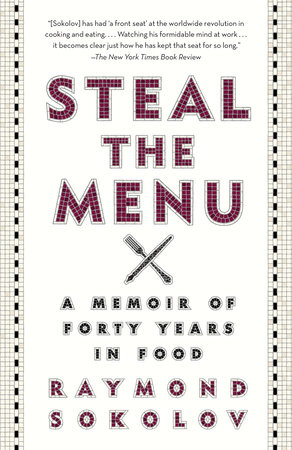

 QUICK VIEW