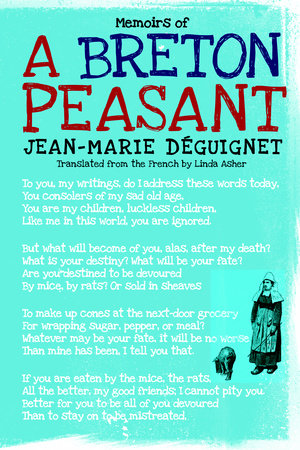
A fascinating document of an extraordinary life, Memoirs of A Breton Peasant reads with the liveliness of a novel and bristles with the vigor of an opinionated autodidact from the very lowest level of peasant society. Brittany during the nineteenth century was a place seemingly frozen in the Middle Ages, backwards by most French standards; formal education among rural society was either unavailable or dismissed as unnecessary, while the church and local myth defined most people’s reasoning and motivation. Jean-Marie Déguignet is unique not only as a literate Breton peasant, but in his skepticism for the church, his interest in science, astronomy and languages, and for his keen—often caustic—observations of the world and people around him.
Born into rural poverty in 1834, Déguignet escapes Brittany by joining the French Army in 1854, and over the next fourteen years he fights in the Crimean war, attends Napoleon III’s coronation ceremonies, supports Italy’s liberation struggle, and defends the hapless French puppet emperor Maximilian in Mexico. He teaches himself Latin, French, Italian and Spanish and reads extensively on history, philosophy, politics, and literature. He returns home to live as a farmer and tobacco-seller, eventually falling back into dire poverty. Throughout the tale, Deguignet’s freethinking, almost anarchic views put him ahead of his time and often (sadly, for him) out of step with his contemporaries.
Déguignet’s voluminous journals (nearly 4,000 pages in total) were discovered in a farmhouse in Brittany a century after they were written. This narrative was drawn from them and became a surprise bestseller when published in France in 1998.







 QUICK VIEW