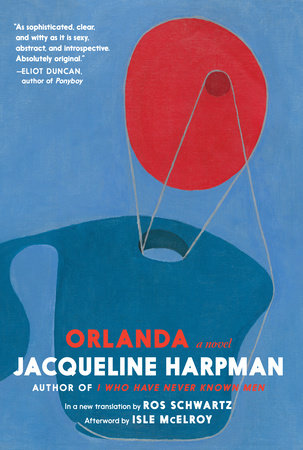
“Luckily for us, Seven Stories Press has just republished Orlanda, a gender-bending romp by the Belgian novelist Jacqueline Harpman that was originally published in 1996 in Belgium (and three years later in the United States, translated by Ros Schwartz). The reissue arrives like a bucket of ice water to the face—it’s a clarifying shock to the system. The more dogmatic we become about gender, the novel reminds us, the more dangerous it becomes for everyone… The triumph of Orlanda, though, is that Harpman makes the lesson tremendously fun. That’s because of her bright and jocular storytelling.” —MJ Franklin, New York Times
“Well written, intriguing, and thoroughly engrossing… [A] most original novel.” —Booklist
“Transit Books’ reissue of ‘I Who Have Never Known Men’ turned into an unexpected hit this year thanks to BookTok and I cannot wait to see what all those readers make of another Harpman reissue, this one riffing on Virginia Woolf’s ‘Orlando’ and the possibility of ever-shifting gender expression, the pains of repression and oppression, and the joys of a bit of queer chaos.”
—Drew Broussard, LitHub, “Most Anticipated Books of 2025”
“Undoubtedly this is a novel to breathe life into characters through the unfettered use of the imagination. It offers a pretext for a great deal of humour and fantasy that stirs up the old myths.”
—André Brincourt, Figaro
“As sophisticated, clear, and witty as it is sexy, abstract, and introspective. Absolutely original.”
—Eliot Duncan, author of Ponyboy
“A twisting, teasing exploration of sexuality, inner motives and desires … Harpman cleverly manipulates an elusive narrative ‘I’ and shifting perspectives in cool, insouciant, yet seductive style, to attack the well-worn existentialist query, ‘Who am I?’” –Publishers Weekly
“Harpman artfully shapes this lighthearted gender confusion into a witty comment on the incompatibility—and interdependency—of the sexes.” –Kirkus Reviews
“Imagination. Jacqueline Harpman certainly doesn’t lack any. . . . With incredible mastery, she juggles with identities, intertwines desires and fears, fantasies and frustrations.” –L’Express
“Orlanda shows Harpman at her wittiest and most delightful.”—Asymptote