Author’s Note
I’d been collecting material to write Clara for years. I had drawers full of papers on conversations with people living in Vienna and New York and London and Tel Aviv. The oldest man I spoke to had seen Emperor Franz Joseph strolling in a Vienna park in 1904. Others had fought in WWI and seen the end of the Dual Monarchy, and many remembered the Great Depression and the years that came after; the street battles in Vienna of the early 30s, the confusion that then finally gave way to National Socialism.
One by one these people passed away and took their stories with them, and I still did not know what to do with what they’d given me. What I felt I needed was the thick folder of documents that I knew existed in my own family. I’d seen it and we’d talked about it: letters hand-written in the old style and giving a flavour of social and private life, photographs and documents from the key years 1930–1950; official forms full of personal questions and threats; Gestapo documents signed and sealed Heil Hitler; birth and death certificates; Work Passes and Marriage Permits; Certificates of Racial Purity. All this documentation with rubber stamps full of eagles and swastikas without which you were nothing.
The way men once planted trees so that their grandchildren might one day enjoy their shade, various people over two generations in my family had assembled these papers into a kind of Lest-we-forget archive for those to come. Over the years the folder became more mythical than real and when I needed it for my research I could not find it. Then the house was sold.
For periods in 2006/7 I lived in Austria on a teaching contract with the Institute for Economic Development. I rented an apartment in a small city with a long history, and from there I travelled by train and road to my seminars.
The apartment was in a castle that had served as a defensive position during the peasant uprisings and the wars of religion of the 1600s and before. Parts of the walls and burial tablets in them went back to the Romans. The best thing about it was the view, which was of an 8th century stone church just across the street. That church and creative elements relating to it are in the story.
In any case, to furnish the place I used some Biedermeier pieces I’d inherited, and while I was cleaning out drawers and compartments I found the document folder. It sat back on a lower shelf, two inches thick, bound with bits of frayed string. Like a nod from fate. A gift, really.
I spent months checking my own material against the documents for historical accuracy, and I experimented with form and voice and dramatic arc of the work I was planning. I was dealing with a generation that had experienced so much: the end of the Austro-Hungarian Empire, WWI, the Great Depression, the rise of Nazism, and WWII and its aftermath.
Eventually I created as the main character for my story a young woman I named Clara Eugenie Herzog, a student at Vienna University in 1932. I would use her stubborn and true love for a man whom everybody in her family disapproved of as the mainspring, and her intellectual, professional and moral development as the backbone of the novel. Once I’d made those framing decisions, it became quite naturally Clara’s story and the material began to flow.
Clara is a novel inspired by actual events set against a background of recorded history and documented fact. Nevertheless, it is a work of the imagination and, except for persons known to history, the names and incidents in the story are either imaginary or are used fictitiously.
K. P.
Summer 2011
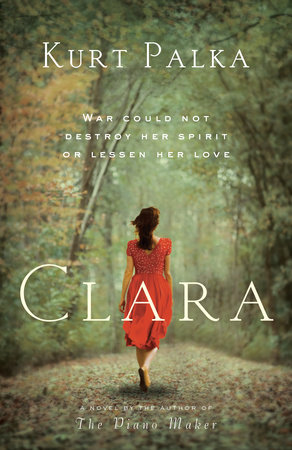
A sweeping tale of love and friendship from the bestselling author of The Piano Maker
Clara Herzog is a privileged, intelligent, and thoughtful young woman whose world is changed forever when 1930s Vienna is swept up by the dark prelude of the Second World War. The cavalry officer she married in spite of her family’s objections is soon called away to the thick of the conflict, and it falls to Clara, as to so many mothers, wives, sisters, and sweethearts through the centuries, to stay at home to provide and protect.
Through the war, its aftermath, and into the present, Clara must make choices and take risks that are as heroic and life-altering as any that men make in battle. She is an unforgettable character, and this is an unforgettable novel about family bonds and women’s deep friendships, about courage and the love that can endure even in unimaginable times.







 QUICK VIEW