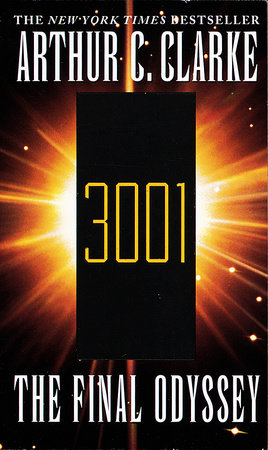
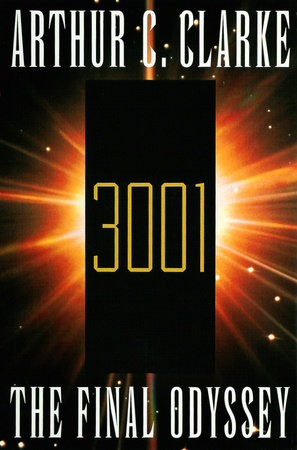
Selected by the Literary Guild® and Doubleday Book Club®
“3001 is not just a page-turner, plugged in to the great icons of HAL and the monoliths, but a book of wisdom too, pithy and provocative.”—New Scientist
The body of Frank Poole, lost for a thousand years since the computer HAL caused his death en route to Jupiter, is retrieved, revived—and enhanced. In the most eagerly awaited sequel of all time, the terrifying truth of the Monoliths’ mission is a mystery only Poole can resolve.
Praise for 3001 The Final Odyssey
“A one man literary Big Bang, Clarke has originated his own vast and teeming futuristic universe.”—Sunday Times
“Well-paced and absorbing . . . It is as a flight of fancy by the master of science fiction that 3001 makes its mark.”—The Times
“In his exciting new novel, Clarke reveals the ominous answer about the ultimate purpose of the monoliths.”—Daily Telegraph
“Serene, uplifting, and icy clear.”—Mail on Sunday
“From the moment I picked it up, I couldn’t put it down. 3001 The Final Odyssey is a tour de force that finally answers the questions that sparked the imaginations of an entire generation.”—Buzz Aldrin
Author
Arthur C. Clarke
Sir Arthur C. Clarke (1917-2008) wrote a hundred books and more than a thousand short stories and essays covering science fiction and science fact in a career spanning more than six decades. Among his bestselling novels are Childhood’s End, 2001: A Space Odyssey, and Rendezvous with Rama. In 1945, he proposed global broadcasting via communication satellites in geostationary orbit. One of his short stories inspired the World Wide Web, while another was expanded into 2001: A Space Odyssey, which he cowrote with Stanley Kubrick. Born in Somerset, England, Clarke was educated at King’s College, London. He worked in the British civil service and the Royal Air Force before turning full-time author in 1950. The recipient of dozens of awards, fellowships, and honorary doctorates, Clarke had both an asteroid and dinosaur species named after him. Queen Elizabeth II gave him a knighthood in 1998. Clarke lived in Sri Lanka since 1956, engaged in diving, astronomical observations, and underwater tourism.
Learn More about Arthur C. Clarke