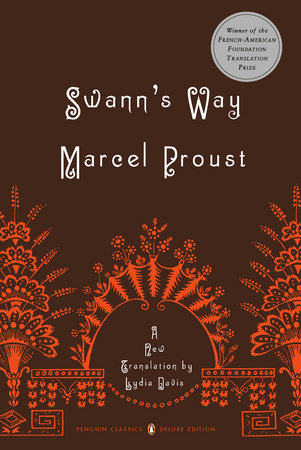



Marcel Proust’s In Search of Lost Time is one of the most entertaining reading experiences in any language and arguably the finest novel of the twentieth century. But since its original prewar translation there has been no completely new version in English. Now, Penguin Classics brings Proust’s masterpiece to new audiences throughout the world, beginning with Lydia Davis’s internationally acclaimed translation of the first volume, Swann’s Way.
Swann’s Way is one of the preeminent novels of childhood: a sensitive boy’s impressions of his family and neighbors, all brought dazzlingly back to life years later by the taste of a madeleine. It also enfolds the short novel “Swann in Love,” an incomparable study of sexual jealousy that becomes a crucial part of the vast, unfolding structure of In Search of Lost Time. The first volume of the work that established Proust as one of the finest voices of the modern age—satirical, skeptical, confiding, and endlessly varied in his response to the human condition—Swann’s Way also stands on its own as a perfect rendering of a life in art, of the past recreated through memory.
Author
Marcel Proust
Marcel Proust was born in the Parisian suburb of Auteuil on July 10, 1871. He began work on In Search of Lost Time sometime around 1908, and the first volume, Swann’s Way, was published in 1913. In 1919 the second volume, Within a Budding Grove, won the Goncourt Prize, bringing Proust great and instantaneous fame. Two subsequent installments—The Guermantes Way (1920–21) and Sodom and Gomorrah (1921)—appeared in his lifetime. The remaining volumes were published following Proust’s death on November 18, 1922: The Captive in 1923, The Fugitive in 1925, and Time Regained in 1927.
Learn More about Marcel Proust