
Best Seller
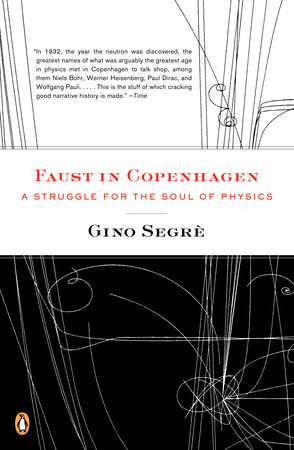
Faust in Copenhagen
By Gino Segre
By Gino Segre
Paperback
$24.00
Published on May 27, 2008 | 336 Pages



Author
Gino Segre
Gino Segrè is professor of physics and astronomy at the University of Pennsylvania. An internationally renowned expert in high-energy elementary-particle theoretical physics, Segrè has served as director of Theoretical Physics at the National Science Foundation and received awards from the National Science Foundation, the Alfred P. Sloan Foundation, and the Guggenheim Foundation. This is his first book.
Learn More about Gino Segre QUICK VIEW
 QUICK VIEW
 QUICK VIEW
 QUICK VIEW
 QUICK VIEW
 QUICK VIEW
 QUICK VIEW
 QUICK VIEW
 QUICK VIEW
 QUICK VIEW