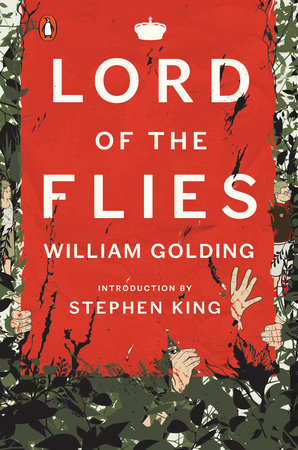
Lord of the Flies Centenary Edition
By William GoldingIntroduction by Stephen King
-
$18.00
Published on Nov 01, 2011 | 304 Pages
“To me Lord of the Flies has always represented what novels are for, what makes them indispensable.” –Stephen King
Golding’s classic, startling, and perennially bestselling portrait of human nature remains as provocative today as when it was first published. This beautiful new edition features French flaps and rough fronts, making it a must-have for fans of this seminal work.
William Golding’s compelling story about a group of very ordinary small boys marooned on a coral island has become a modern classic. At first it seems as though it is all going to be great fun; but the fun before long becomes furious and life on the island turns into a nightmare of panic and death. As ordinary standards of behaviour collapse, the whole world the boys know collapses with them—the world of cricket and homework and adventure stories—and another world is revealed beneath, primitive and terrible.
Lord of the Flies remains as provocative today as when it was first published in 1954, igniting passionate debate with its startling, brutal portrait of human nature. Though critically acclaimed, it was largely ignored upon its initial publication. Yet soon it became a cult favorite among both students and literary critics who compared it to J.D. Salinger’s The Catcher in the Rye in its influence on modern thought and literature.
Labeled a parable, an allegory, a myth, a morality tale, a parody, a political treatise, even a vision of the apocalypse, Lord of the Flies has established itself as a true classic.
Author
William Golding
William Golding (1911– 1993) was born in Cornwall, England, in 1911 and educated at Oxford University. His first book, Poems, was published in 1934. Following a stint in the Royal Navy and other diversions during and after World War II, Golding wrote his first novel, Lord of the Flies (1954), while teaching school. Many novels followed, including The Inheritors (1955), Pincher Martin (1956), and Free Fall (1959), as well as a play, The Brass Butterfly (1958), and a collection of shorter works, The Hot Gates and Other Occasional Pieces (1965). He received the James Tait Black Memorial Prize for Darkness Visible (1979) and the Booker Prize for Rites of Passage (1980). In 1983, he was awarded the Nobel Prize in Literature “for his novels which, with the perspicuity of realistic narrative art and the diversity and universality of myth, illuminate the human condition in the world of today.” He was a member of the Royal Society of Literature and was knighted by Queen Elizabeth II in 1988. William Golding died in June 1993 and is buried in Holy Trinity churchyard in Bowerchalke, Wiltshire, in England.
Learn More about William Golding