National Bestseller
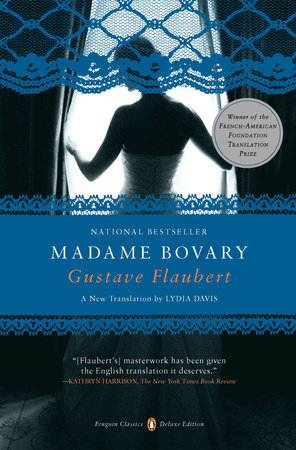
Winner of the French-American Foundation Translation Prize
One of New York magazine’s Ten Best Books of the Year
A Providence Journal Best Book of the Year
One of National Public Radio’s Favorite Books of the Year
“Lydia Davis’s Madame Bovary translation=perfect. She somehow pulls off a respectful translation with the readability of a contemporary novel.” —@lenadunham
“[Flaubert’s] masterwork has been given the English translation it deserves.” —Kathryn Harrison, The New York Times Book Review
“Invigorating . . . [Davis] has a finer ear for the natural cadences of English, in narrative and dialogue, than any of her predecessors.” —Jonathan Raban, The New York Review of Books
“Dazzling . . . translated to perfect pitch . . . [Davis has] left us the richer with this translation. . . . I’d certainly say it is necessary to have hers.” —Jacki Lyden, NPR.org, Favorite Books of the Year
“One of the most important books of the year . . . Flaubert’s strict, elegant, rhythmic sentences come alive in Davis’s English.” —James Wood, The New Yorker‘s Book Bench
“I liked having a chance to find more nuances in Madame Bovary in the new Lydia Davis translation and read it blissfully as though floating, as Flaubert puts it in a different context, ‘in a river of milk.'” —Paul Theroux, The Guardian (London), Books of the Year
“Madame Bovary reads like it was written yesterday. . . . Emma, with her visions of a grander life and resplendent passions, is me . . . and you, too, no doubt. . . . If you haven’t happened to read Madame Bovary until now, I suggest you curl up with this edition . . . and allow yourself to get lost in another time and place that yet bears a curious resemblance to our own.” —Daphne Merkin, Elle
“Davis is the best fiction writer ever to translate the novel. . . . [Her] work shares the Flaubertian virtues of compression, irony and an extreme sense of control.” —Julian Barnes, London Review of Books
“A brilliant new translation.” —Lee Siegel, The New York Observer
“I’m grateful to Davis for luring me back to Madame Bovary and for giving us a version which strikes me as elegant and alive.” —Maureen Corrigan, NPR’s Fresh Air
“Flaubert’s obsessive masterpiece finally gets the obsessive translation it deserves.” —New York magazine







 QUICK VIEW