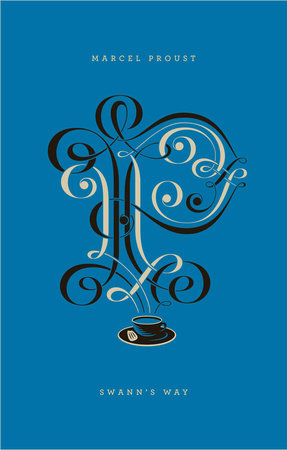
It all begins with a letter. Fall in love with Penguin Drop Caps, a new series of twenty-six collectible and hardcover editions, each with a type cover showcasing a gorgeously illustrated letter of the alphabet. In a design collaboration between Jessica Hische and Penguin Art Director Paul Buckley, the series features unique cover art by Hische, a superstar in the world of type design and illustration, whose work has appeared everywhere from Tiffany & Co. to Wes Anderson’s recent film Moonrise Kingdom to Penguin’s own bestsellers Committed and Rules of Civility. With exclusive designs that have never before appeared on Hische’s hugely popular Daily Drop Cap blog, the Penguin Drop Caps series debuted with an ‘A’ for Jane Austen’s Pride and Prejudice, a ‘B’ for Charlotte Brönte’s Jane Eyre, and a ‘C’ for Willa Cather’s My Ántonia. It continues with more perennial classics, perfect to give as elegant gifts or to showcase on your own shelves.
P is for Proust. Swann’s Way is one of the preeminent novels of childhood: a sensitive boy’s impressions of his family and neighbors, all brought dazzlingly back to life years later by a taste of a madeleine. It also enfolds the short novel “Swann in Love,” an incomparable study of sexual jealousy that becomes a crucial part of the vast, unfolding structure in In Search of Lost Time. The first volume of the work that established Proust as one of the finest voices of the modern age—satirical, skeptical, confiding, and endlessly varied in his response to the human condition—Swann’s Way also stands on its own as a perfect rendering of a life in art, of the past recreated through memory.







 QUICK VIEW