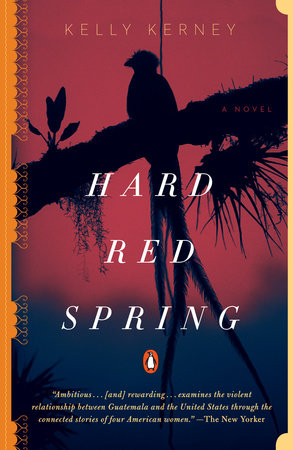
An Interview with Kelly Kerney:
1. Your first novel, Born Again, was partly based on your own experiences growing up as an evangelical Christian. What inspired you to write an epic novel about American intervention in Guatemala?
I took a modern Latin American history class during my undergraduate years and it opened up my sheltered view of the world in so many ways—probably more than anything else in those first few years away from home. After I wrote my first novel, once I figured out how to write novels, I knew I had to write about this surreal and tragic history.
2. Was Evie’s story based on a real historical incident?
Yes. In October of 1902, the Santa María volcano erupted in the Guatemalan Highlands, while foreign investors were touring the country. Since Guatemala already had a reputation for both geological and social instability, the president tried to cover up the eruption. He printed decrees in the newspaper denying the event, clamped down on communications from the affected area, and even sent a band to the town of Xela to play over the noise of the eruption.
3. Did you start the book with the four primary characters—Evie, Dorie, Lenore, and Jean—already in mind? Whose world was the most difficult to inhabit?
Yes, I pretty much always had those characters in mind, though they did not all come to me easily. Dorie proved to be the most troublesome. I wrote about a hundred more pages for that section that did not make it into the final book, writing just to find my way to her.
4. What kind of research did you do to write this novel?
I adopted a full immersion strategy, drawing on history books, Mayan myth, fables, interviews, guide books, academic articles, memoirs, media reportage, CIA publications, trial testimony, NGO reports, and observations from my own travels.
5. How many times have you visited Guatemala? When was the last time you were there, and how has the country changed since 1999?
I’ve visited Guatemala three times, the last time being in 2006. Since then, the country has been ravaged by drug violence. Because of the immunities granted in the 1996 peace accords, many officials who were involved in the dirty war remain in positions of power. From there, they have easily moved into the more financially lucrative organized crime circles that, unsurprisingly, have become indistinguishable from the government. Drug cartels have proliferated. For the past few years, Guatemala has had the fifth-highest murder rate in the world. And this is supposedly peacetime.
6. How much of what happens in the book is fact and how much is fiction?
The larger events—detailed in the timeline—are true, whereas all the characters are either fictionalized versions of real actors or just straight fiction. All four protagonists are entirely fictional.
7, As a former evangelical Christian, was it difficult to write about Pat Robertson’s role in the genocide that happened in the 1980s?
No. Robertson’s manipulation of his audience’s fear and ignorance became so clear to me as an adolescent. The difficulty came in separating him from the actions of his mostly well-meaning fans.
8. In your novel, is there a character with whom you feel a particular affinity?
Continuing the thread of the previous question, I think that I came to understand Lenore the best. She is the most well-meaning of the characters, although her involvement turns out to be the most direct, destructive, and disturbing of all four protagonists. These extremes make her, in my mind, a truly tragic character.
9. Was there something about Guatemala that made it so vulnerable to outside powers? Or is what happened there more common than we like to think?
The U.S.—compelled by business interests and/or anti-Communist paranoia—has orchestrated the overthrow of and/or fueled civil war against democratically-elected leaders in many countries. For anyone interested in learning more, I suggest reading Legacy of Ashes: The History of the CIA by Tim Weiner.
10. Hard Red Spring is a gripping, beautifully told, and unabashedly political novel. Do you feel it’s a writer’s responsibility to educate readers?
Literature can serve many purposes, so I’d never venture to say what any writer’s responsibility should be. And though readers tend to call this novel political, I never really saw it that way. For me, it is a work of the imagination, inspired by real events and meant to explore the smaller human truths catalyzing those events. More importantly, however, American privilege allows many of us to mentally separate real life and politics. Many, many people in the world are not so lucky. For the majority of Guatemalans, what we call politics here has dictated the daily business of life for much of the past century. For them, there is no distinction.
11. Who are some of your literary influences?
Graham Greene, Flannery O’Connor, V. S. Naipaul, Thomas Hardy, Edith Wharton, Alice Munro, Herman Melville, Ralph Ellison, and Willa Cather.
12. What are you working on now?
A third novel.







 QUICK VIEW