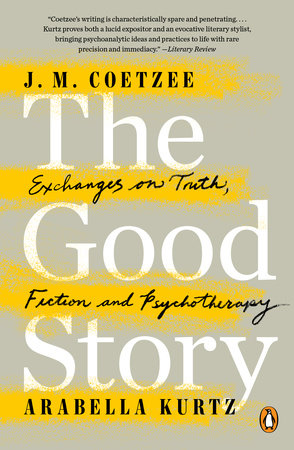
J.M. Coetzee: What relationship do I have with my life history? Am I its conscious author, or should I think of myself as simply a voice uttering with as little interference as possible a stream of words welling up from my interior?
Arabella Kurtz: One way of thinking about psychoanalysis is to say that it is aimed at setting free the narrative or autobiographical imagination.
The Good Story is a fascinating dialogue about psychotherapy and the art of storytelling between a writer with a long-standing interest in moral psychology and a psychotherapist with training in literary studies. Coetzee and Kurtz consider psychotherapy and its wider social context from different perspectives, but at the heart of both of their approaches is a concern with narrative. Working alone, the writer is in control of the story he or she tells. The therapist, on the other hand, collaborates with the patient in developing an account of the patient’s life and identity that is both meaningful and true.
In a meeting of minds that is illuminating and thought-provoking, the authors discuss both individual psychology and the psychology of the group: the school classroom, gangs and the settler nation, in which the brutal deeds of ancestors are accommodated into a national story. Drawing on great writers like Cervantes and Dostoevsky and psychoanalysts like Freud and Melanie Klein, Coetzee and Kurtz explore the human capacity for self-examination, our wish to tell our own life stories and the resistances we encounter along the way.
Author
J. M. Coetzee
Born in Cape Town, South Africa, on February 9, 1940, J. M. Coetzee studied first at Cape Town and later at the University of Texas at Austin, where he earned a PhD degree in literature. In 1972, he returned to South Africa and joined the faculty of the University of Cape Town. His works of fiction include Dusklands; Waiting for the Barbarians, which won South Africa’s highest literary honor, the Central News Agency Literary Award; and the Life and Times of Michael K., for which Coetzee was awarded his first Booker Prize in 1983. He has also published a memoir, Boyhood: Scenes From a Provincial Life, and several essay collections. He has won many other literary prizes, including the Lannan Award for Fiction, the Jerusalem Prize, and the Irish Times International Fiction Prize. In 1999, he again won Britain’s prestigious Booker Prize for Disgrace, becoming the first author to win the award twice in its 31-year history. In 2003, Coetzee was awarded the Nobel Prize in Literature.
Learn More about J. M. CoetzeeAuthor
Arabella Kurtz
Arabella Kurtz is a consultant clinical psychologist and is completing psychoanalytic psychotherapy training at the Tavistock Clinic in London. She has held various posts in the National Health Service adult and forensic mental health services and is currently a senior clinical tutor in the University of Leicester clinical psychology training course. Kurtz lives in England.
Learn More about Arabella Kurtz