“A good yarn and a timely one — appearing as Americans are once again pondering the possibility of war with North Korea.”
—Mary Louise Kelly, Washington Post
“Compellingly told.”
—St. Louis Post-Dispatch
“[A] masterful work of narrative history.”
—South China Morning Post
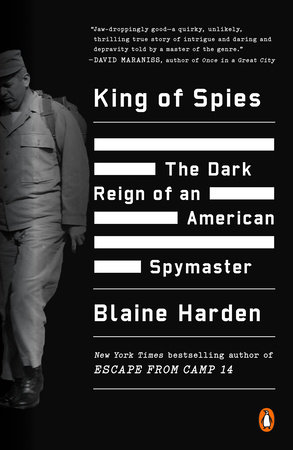
“A rip-roaring exposé . . . King of Spies is set in the 1940s and 50s, but the conundrum at its center is timeless: do the ends of effective espionage justify the actions of dangerous men employing dubious means? With 21st century America globally engaged in black operations, under questionable oversight, that question remains as pertinent today as ever.” —Asia Times
“Provocative . . . a must-read.”
—Library Journal (starred review)
“Harden’s Nichols is both a victim and an exemplar of a war that ‘most Americans never debated, let alone understood.'”
—Publishers Weekly
“An engrossing hidden history of wartime espionage, with elements of derring-do and moral barbarity. . . . [Harden] ably connects his ominous central figure to the larger mysterious, unresolved narrative of the Korean conflict….Fascinating.”
—Kirkus Reviews
“Jaw-droppingly good — a quirky, unlikely, thrilling true story of intrigue and daring and depravity told by a master of the genre.”
—David Maraniss, author of Once in a Great City: A Detroit Story
“King of Spies is a dark story of espionage and evil by a wild American military spymaster in Korea, a tale both revelatory and tragic. Blaine Harden’s superb book throws open a long-ignored chapter in the Korean War; a compelling and disturbing read, not to be missed.”
—David E. Hoffman, author of The Billion Dollar Spy: A True Story of Cold War Espionage and Betrayal
“Blaine Harden has now produced a fascinating trilogy of stranger-than-fiction books about North Korea. His latest, King of Spies, is about a gay middle school dropout who was one of the few U.S. officials to predict the outbreak of the Korean War and whose espionage activities had a profound impact on the course of the war. You’ve probably never heard of Donald Nichols, but you’ll never forget him after reading King of Spies.”
—Barbara Demick, author of Nothing to Envy: Ordinary Lives in North Korea
“A thrilling real-life spy story told by a terrific writer.”
—Tim Weiner, author of Legacy of Ashes: The History of the CIA
“Blaine Harden has done what no one else thought to do in seven decades: He’s brought us the full, secret, astonishing story of one of the most improbably powerful characters in American history, and he has done so with crystalline writing and in jaw-dropping detail.”
—Steve Twomey, author of Countdown to Pearl Harbor: The Twelve Days to the Attack
“Many accounts of the Korean War are full of mystery, hinting at horrific crimes and large-scale covert operations. King of Spies pierces that mystery through the story of a remarkable American operative who took his mission to mind-boggling extremes. The adventures that fill these pages, from bleak battlefields to the corridors of power, tell us much about how the world really works.”
—Stephen Kinzer, author of Overthrow: America’s Century of Regime Change from Hawaii to Iraq
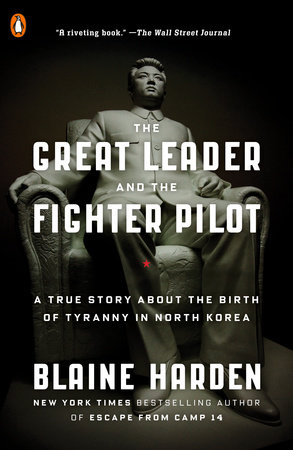
Praise for The Great Leader and the Fighter Pilot:
“Blaine Harden has done more than anyone else to bring [North Korea] to a mass audience. . . . Thrilling stuff.”
—The Washington Post
“A riveting book that makes the history of North Korea accessible to the general reader.”
—Wall Street Journal
“An eminently readable picture of our most under-remembered war.”
—The Daily Beast
Praise for Escape From Camp 14:
“Harden’s book, besides being a gripping story, unsparingly told, carries a freight of intelligence about this black hole of a country.”
—Bill Keller, The New York Times
“A remarkable story.”
—The Wall Street Journal
“A riveting new biography . . . If you want a singular perspective on what goes on inside the rogue regime, then you must read [this] story.”
—CNN







 QUICK VIEW