Part of Classic, 20th-Century, Penguin
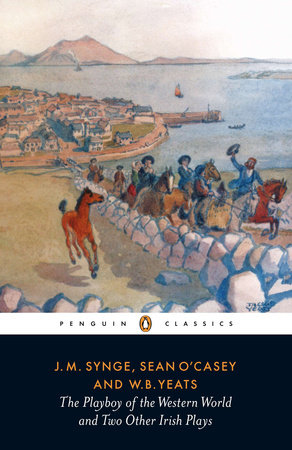
The Playboy of the Western World and Two Other Irish Plays
By J. M. Synge, William Butler Yeats and Sean O’CaseyIntroduction by W. A. Armstrong
-
$15.00
Published on May 01, 1997 | 224 Pages
The plays that helped make modern Ireland
Author
J. M. Synge
John Millington Synge was born in 1871 into an old Anglo-Irish family. Due to ill health he was educated mainly by private tutors before studying at Trinity College, Dublin, and the Royal Irish Academy of Music. He went to Germany to continue his musical studies in 1893 and then, turning to literature, moved to Paris in 1895. There he met W. B. Yeats, who suggested he go to the Aran Islands to live with the islanders as one of them and to “express a life that has never found expression.” He spent a few weeks on the islands each year from 1898 to 1902. The Aran Islands did not appear until 1907, but it was his experiences in Aran that gave him the plots of his plays In the Shadow of the Glen (1903), The Riders to the Sea (1904), and The Well of the Saints (1905). His emergence as a playwright coincided with and furthered the Irish dramatic revival. He was first a literary advisor and then a director of the Abbey Theatre in Dublin, where the first performances of his plays provoked violent controversies. His most famous work, The Playboy of the Western World, which was suggested by an anecdote he had heard in Aran, unleashed a riot in the theater at its first performance in 1907. Synge was in love with the young actress, Molly Allgood, who played the principal female role in the play, and it was she who inspired Deirdre of the Sorrows, a play that was left unfinished by his early death in 1909. Another of his earlier plays, The Tinker’s Wedding, had been regarded both by Synge and Yeats as too dangerous to perform in Dublin, and it was not seen there until 1971.
Learn More about J. M. SyngeAuthor
William Butler Yeats
William Butler Yeats (1865–1939) was born in Dublin. Yeats was educated in London and in Dublin, but he spent his summers in the west of Ireland in the family’s summer house at Connaught. The young Yeats was very much part of the fin de siècle in London; at the same time he was active in societies that attempted an Irish literary revival. His first volume of verse appeared in 1887, but in his earlier period his dramatic production outweighed his poetry both in bulk and in import. Together with Lady Gregory he founded the Irish Theatre, which was to become the Abbey Theatre, and served as its chief playwright until the movement was joined by John Synge. His plays usually treat Irish legends; they also reflect his fascination with mysticism and spiritualism. The Countess Cathleen (1892), The Land of Heart’s Desire (1894), Cathleen ni Houlihan (1902), The King’s Threshold (1904), and Deirdre (1907) are among the best known. Although a convinced patriot, Yeats deplored the hatred and the bigotry of the Nationalist movement, and his poetry is full of moving protests against it. He was appointed to the Irish Senate in 1922. His poetry, especially the volumes The Wild Swans at Coole (1919), Michael Robartes and the Dancer (1921), The Tower (1928), The Winding Stair and Other Poems (1933), and Last Poems and Plays (1940), made him one of the outstanding and most influential twentieth-century poets writing in English.
Learn More about William Butler YeatsAuthor
Sean O'Casey
Sean O’Casey was born in Dublin in 1880. In 1926 he moved to England. He discouraged any professional performances of his plays in Ireland after the Archbishop of Dublin refused to inaugurate the Dublin festival if O’Casey’s play The Drums of Father Ned (1958) was included. O’Casey died in 1964.
Learn More about Sean O'Casey