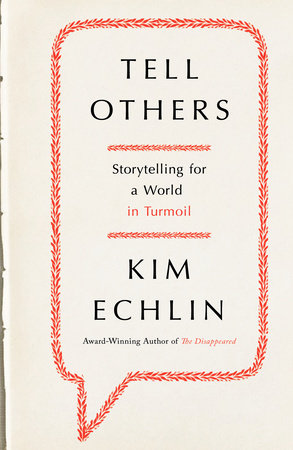
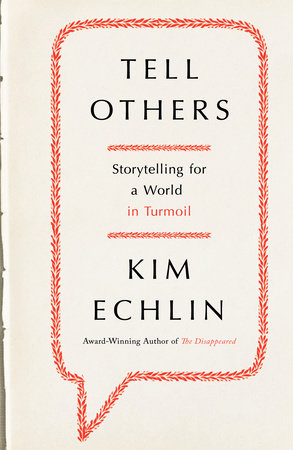
Praise for Tell Others:
“In Tell Others, Kim Echlin brilliantly analyzes the importance of literature in resisting censorship when voices that dare to question the narrative of those in power are threatened. Timely, insightful, and beautifully written, this book invites us to ask questions and to allow the stories that carry our human experience to rise above dogmatic ideologies that claim to have all the answers.”
—Marina Nemat, internationally bestselling author of Prisoner of Tehran
“A fine Canadian writer’s deep, readable, compassionate and unflinching effort to understand why human beings tell each other stories, even about the most terrible experiences. What Echlin achieves is remarkable, a quiet but stirring affirmation that there is nothing, literally nothing, that human beings cannot find a way to endure and overcome provided that they can find the words and tell their story to someone who will listen.”
—Michael Ignatieff, author of On Consolation: Finding Solace in Dark Times
“I can’t stop thinking about this beautiful book. Tell Others is rooted in great generosity and profound curiosity, addressing three questions essential to our humanity: How can I best listen? How do I speak? and What can I do? I closed this book feeling hopeful that art will rescue us from the shackles of certainty, and help us come to terms with what happened on our watch if we listen, make the unspeakable speakable, and through our actions, create a new story.”
—Shelagh Rogers, Honorary Witness, Truth and Reconciliation Commission of Canada and CBC literary host
“In these days of willful deafness, Echlin’s loud and clear voice is a rallying call for vital and enlightening dialogue. This is an absolutely necessary book.”
—Alberto Manguel, author of A History of Reading
“With clarity, courage and rich compassion, Echlin reflects on authors such as Milan Kundera, Toni Morrison and Margaret Atwood, using their works to illuminate the realities of tyranny, war, sexual violence and censorship. Yet rather than leave us in despair, Tell Others carves a path forward toward remembrance, resistance and transformation. It is at once a witness-memoir and a celebration of stories that refuse to stay silent. Echlin’s collection of essays also acts as a bulwark against the ever-widening ideological gaps of our times. It is a call to all of us: to listen, to bear witness, and to speak the truths that cannot be silenced.”
—Samira Mohyeddin, award-winning journalist, broadcaster, and producer
“Censorship, testimony, translation, silencing, and listening—these five words are the beautiful and timely spine of this story. Taking some of the most difficult historical violences of our times as the incitement to read otherwise, Echlin shows the ways in which fiction provides readers a moment of respite. In these pages, the words, language, and stories of others quietly provide us the possibility of community, of refusal, of renewal and of what is possible when we make ourselves available to other accounts of what it means to live a life. We read the writer reading and we share a certain unity through words that produce liberating sensations for collective possibilities beyond despair.”
—Rinaldo Walcott, author of The Long Emancipation: Moving Toward Black Freedom







 QUICK VIEW