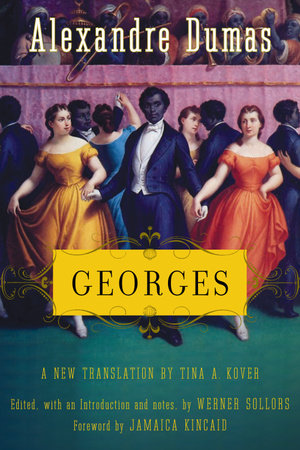
A major new translation of a stunning rediscovered novel by Alexandre Dumas, Georges is a classic swashbuckling adventure. Brilliantly translated by Tina A. Kover in lively, fluid prose, this is Dumas’s most daring work, in which his themes of intrigue and romance are illuminated by the issues of racial prejudice and the profound quest for identity.
Georges Munier is a sensitive boy growing up in the nineteenth century on the island of Mauritius. The son of a wealthy mulatto, Pierre Munier, Georges regularly sees how his father’s courage is tempered by a sense of inferiority before whites–and Georges vows that he will be different.
When Georges matures into a man committed to “moral superiority mixed with physical strength,” the stage is set for a conflict with the island’s rich and powerful plantation owner, Monsieur de Malmédie, and a forbidden romance with Sara, the beautiful woman engaged to Malmédie’s son.
Swordplay, a slave rebellion, a harrowing escape, and a vow of vengeance–Georges is unmistakably the work of the master who wrote The Three Musketeers and The Count of Monte Cristo. Yet it stands apart as the only book Dumas ever wrote that confronts the subject of race–a potent topic, since Dumas was of African ancestry himself.
This edition also features a captivating Introduction by Jamaica Kincaid and an eloquent Afterword and Notes by Werner Sollors, who addresses key themes such as colonialism, racism, African slavery, and interracial intimacy.
Long out of print in America, Georges can now be appreciated as never before and added to the greatest works of this immortal author.








 QUICK VIEW