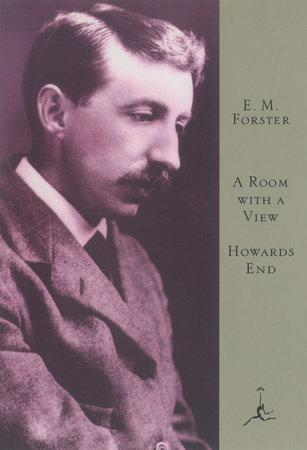

‘To me,’ D. H. Lawerence once wrote to E. M. forster, ‘you are the last Englishman.’ Indeed, Forster’s novels offer contemporary readers clear, vibrant portraits of life in Edwardian England. Published in 1908 to both critical and popular acclaim, A Room with a View is a whimsical comedy of manners that owes more to Jane Austen that perhaps any other of his works. The central character is a muddled young girl named Lucy Honeychurch, who runs away from the man who stirs her emotions, remaining engaged to a rich snob. Forster considered it his ‘nicest’ novel, and today it remains probably his most well liked. Its moral is utterly simple. Throw away your etiquette book and listen to your heart. But it was Forster’s next book, Howards End, a story about who would inhabit a charming old country house (and who, in a larger sense, would inherit England), that earned him recognition as a major writer. Centered around the conflict between the wealthy, materialistic Wilcox family and the cultured, idealistic Schlegel sisters-and informed by Forester’s famous dictum ‘Only connect’-it is full of tenderness towards favorite characters. ‘Howards End is a classic English novel . . . superb and wholly cherishable . . . one that admirers have no trouble reading over and over again,’ said Alfred Kazin.
Author
E.M. Forster
Edward Morgan Forster was born on January 1, 1879, in London and was raised from infancy by his mother and paternal aunts after his father’s death. Forster’s boyhood experiences at the Tonbridge School, Kent, were an unpleasant contrast to the happiness he found at home, and his suffering left him with an abiding dislike of the English public school system. At King’s College, Cambridge, however, he was able to pursue freely his varied interests in philosophy, literature, and Mediterranean civilization, and he soon determined to devote his life to writing. His first two novels, Where Angels Fear to Tread (1905) and The Longest Journey (1907), were both poorly received, and it was not until the publication of Howards End, in 1910, that Forster achieved his first major success as a novelist, with the work many considered his finest creation. Forster first visited India during 1912 and 1913, and after three years as a noncombatant in Alexandria, Egypt, during World War I and several years in England, he returned for an extended visit in 1921. From those experiences came his most celebrated novel, A Passage to India, his darkest and most probing work and perhaps the best novel about India written by a foreigner. As a man of letters, Forster was honored during and after World War II for his resistance to any and all forms of tyranny and totalitarianism, and King’s College awarded him a permanent fellowship in 1949. He spent his later years at Cambridge writing and teaching, and died in Coventry, England, on June 7, 1970. His novel, Maurice, written several decades earlier, was published posthumously in 1971.
Learn More about E.M. Forster