READERS GUIDE
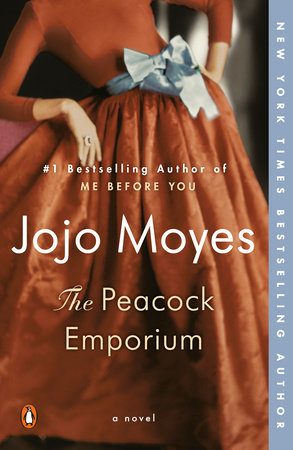
AN INTRODUCTION TO THE PEACOCK EMPORIUM Jojo Moyes became a household name with her
New York Times bestselling
Me Before You trilogy (
Me Before You,
After You, and
Still Me), and especially for her trademark memorable characters and complex, true-to-life relationships. Moyes brings all of that to
The Peacock Emporium, a rich story of a young woman with a mysterious past who finds both safety and salvation in the quirky shop she opens in her small town.
Athene Forster was untouchable. Dubbed the “Last Deb,” she was gorgeous, rich, and could have anything—or anyone—she wanted, including young heir Douglas Fairley-Hulme. Two years into their marriage, however, scandal engulfs the couple after a young salesman catches Athene’s eye, ultimately causing her fall from grace.
Thirty-five years later, Suzanna Peacock is drowning in the shadow of her late mother, Athene. Unhappy in her marriage and desperate for a fresh start, Suzanna opens The Peacock Emporium, an eclectic shop that attracts an eccentric cast of characters. In her new role, Suzanna begins opening up, and even finds a true friend in Alejandro, a male midwife. But despite her efforts, Suzanna is unable to escape the specter of her mother. It will take tragedy, heartbreak, and ultimately healing for Suzanna to learn that only by confronting the ghosts of her past can she finally begin to live in the present.
Like all Moyes’s books,
The Peacock Emporium will steal your heart—and is an absolutely unputdownable, unforgettable read.
A CONVERSATION WITH JOJO MOYES The characters in the novel—Suzanna, Alejandro, Vivi, Athene to name just a few—are incredibly complex, though some sober and reflective, while others have a much louder joie de vivre. What led you to these characters, and how did this story come about? I never really know what leads me to characters. Most fall, to some extent, into my lap—or at least their skeletons do. And then I build bits of them on top of that framework. Sometimes I look back and realize they reflect something in my own life—in the case of
Peacock, I wrote it when I was adjusting to life in a small town after spending thirty years in London so I’m sure there’s a bit of me in Suzanna.
Family and class are both significant themes in this book—and in some of your other books as well—and we see Suzanna, Douglas, and others chaffing at their tethers. What is it about issues of class that makes it important to you? I think if you live in England it’s very hard to escape issues of class, especially in market towns where the house you live in or the family you come from often give away your background. I suppose I just find it a useful source of tension as a writer—there is always someone in the wrong place.
Without giving anything away, the ending is truly a remarkable and unexpected twist. Did you know in advance that this is how you would end it, or did the conclusion come about as you worked, slowly revealing itself to you? If I have a twist (and I usually do) I always plot it beforehand. I don’t think it’s possible to write free-form toward one. I wanted the reader to think of Athene a certain way—to see her largely through the eyes of everyone else—and then realize that the story they’ve been told might have been something else entirely. So yes, I always knew what I was working toward.
Suzanna flounders beneath her eccentric mother’s legacy, but eventually finds her way with the success of the Peacock Emporium. It is only when she takes the initiative in seeking her own happiness that she finds contentment. Why was it important to you to show this transformation, especially in a female character? I think it’s become an undercurrent in my books—female contentment and emancipation through work! Or at least working out what you love to do. I didn’t think Suzanna was the kind of character who would ever be properly satisfied without that—she reminded me of some mothers I was around when writing this who poured their energy into soft furnishings or playgroups but were somehow always restless and dissatisfied. I think it’s such a gift to know what really makes you happy.
How did you decide to structure the novel as you did? The first few chapters highlight Athene’s wild beginnings, and then you soon turn to Suzanna’s much more conventional story. Did you ever consider alternating their perspectives chapter by chapter? It’s probably the most challenging structure I’ve ever attempted—at least for the reader. I didn’t consider alternating the chapters because sometimes that can make the narrative flow a little choppy, and I thought the reader needed to spend a little time with the background. But I do love playing with structure so who knows? Perhaps I should have done.
You have written both contemporary and historical novels, and some, like this one, have dual timeframes within them. (The Last Letter From your Lover is another one, as is The Girl You Left Behind.) What attracts you to these kinds of dual stories? I think the key difference with the older work and the work from
Me Before You onward is the humor. Most of the books I’ve written since 2010 have a lot of humor in them. And I don’t know what attracts me to dual timeframes—really it just depends on the story that won’t leave my head and how I think it can best be told. The book I’ve just completed is almost completely linear, bar the prologue.
What are you working on now? I’m just editing my new book, which is completely different—and a bit of a departure. I’m probably more excited about it than anything I’ve ever worked on. I don’t want to say too much but it’s set in Kentucky and based on something that happened in real life, and while researching it I totally fell in love with that state in a way I’d completely not expected. So I hope readers enjoy it!
QUESTIONS AND TOPICS FOR DISCUSSION 1. The Peacock Emporium is about Suzanna coming to terms with her family and her past, but it is also a love story, as well as an ensemble piece about the ways a small town reacts around issues of domestic violence. Do you think the elements came together to create a realistic and cohesive narrative? Why or why not? Which storyline compelled you the most?
2. In this novel, Suzanna must reckon with her mother’s scandalous past and the way in which this history affects her own identity. How important a role do you think parents’ lives should play in the foundation of one’s own identity?
3. Suzanna, the protagonist, is an enigma to the end. She continually denies her true feelings, and is stalled in life out of passivity, confusion, and fear, yet these are very understandable human reactions. Did you understand why Suzanna decided to keep everything to herself, and why she had trouble letting others get close to her? What do you think motivates her? Is it her unhappiness and feelings of not belonging or being good enough—or something else entirely? Or why do you think she’s so unhappy in her marriage?
4. Some of the great joys of this novel are the wonderful secondary characters, such as Arturro, Father Lenny, Mrs. Creek, etc. Which of these characters stood out most for you? Did you relate personally to any of them? In what ways?
5. Suzanna makes a point of not inviting her husband, Neil, to the opening of the Peacock Emporium, because she “wanted something that was hers, pure and pleasurable, untainted by her and Neil’s history. Uncomplicated by
people” (p. 83). What do you think she meant by this?
6. Suzanna is so different from the rest of the Fairley-Hulmes—both emotionally and in terms of her outlook on life. How do you think these differences helped or hindered her relationships within her family? How do they shape her choices regarding the shop?
7. How did you come to understand Suzanna and Neil’s marriage? Did you understand and believe in the relationship that develops between her and Arturro, and did you anticipate what happened between them?
8. Did you like the way the ending connected to the beginning of the novel, having come full circle? Did you think it made for a satisfying ending?