A Conversation with David A. Kaplan
Author of
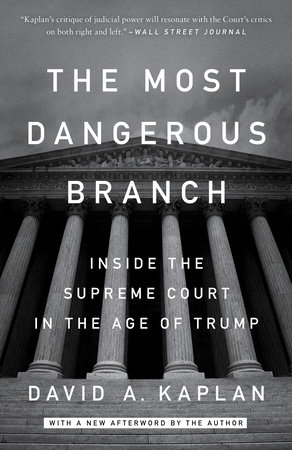
THE MOST DANGEROUS BRANCH
Inside the Supreme Court’s Assault on the Constitution
(Crown; September 4, 2018)
Q) You were the legal affairs editor at Newsweek for a decade. Why did you want to write this book?
A) After Antonin Scalia died in 2016, I kept hearing liberals and conservatives both hollering that “the next justice” could shape social policy “for a generation.” And nobody questioned that power. I aimed to challenge the orthodoxy. Anthony Kennedy’s retirement—just as I finished —made the timing particularly auspicious.
Q) There have been many books about the Court, including some by justices. What sets THE MOST DANGEROUS BRANCH apart?
A) I like to think it challenges the conventional wisdom held by justices, presidents, senators and observers. Plus, I hope the stories in the book offer an intimate look behind the scenes of this most secretive institution.
Q) You argue the Court repeatedly overreaches. Can you explain?
A) The Court often issues rulings that run against popular opinion. That’s part of the job. But too often the justices intervene when they shouldn’t—whether on guns or campaign finance or abortion or same-sex marriage. Though it claims otherwise, the Court lacks institutional humility. It wasn’t always like that.
Q) You interviewed a majority of the current justices and dozens of former law clerks—as well as presidents, White House aides and administration officials. What surprised you?
A) A lot surprised me, which is one of the joys of writing a book. Some items: the chief justice’s indignation in 2016 at attacks on him by Republican candidates; how strongly many justices feel about Gorsuch; how little Trump understands about the Court; who Obama preferred to nominate instead of Merrick Garland; why Sandra Day O’Connor voted as she did in Bush v. Gore; and Clarence Thomas still being really mad.
Q) How do you think Gorsuch compares to Scalia?
A) He’s mostly as advertised—rock-ribbed conservative and 30 years younger. Trump hopes his newest nominee, Brett Kavanaugh, is like Gorsuch—giving resolute control of the Court to the conservative bloc.
Q) You point out how the Court vacancy was a big factor in the 2016 election. What’s the significance?
A) Polls show many voters made their decision based on it. That made total sense—and is precisely the problem I’m trying to describe. It is surely not ideal that voters choose not on a presidential candidate’s character or policy positions, but chiefly on who they think will be nominated to the Court.
Q) What do you hope readers take away from the book?
A) I hope readers will think differently about the Court’s role—and also that they’ll come away knowing more about these important nine individuals. The Court isn’t Olympus and the justices aren’t omniscient rulers.
Q) What is the solution for the problem you describe in THE MOST DANGEROUS BRANCH?
A) Ideally, there would be term limits for justices—say, a single 18-year term, staggered so every president gets to nominate. For starters, that would reduce pressure on presidents to name ever-younger justices. But such a change would require a constitutional amendment—which won’t happen. Better to hope a president and Senate someday recognize it is time to begin appointing more deferential, less triumphal justices.
Q) Your online bio mentions that several years ago you finished in 5th place out of 13,000 in the tryouts to be the new voice of the Aflac Duck.
A) Initially, I was to write an article on the tryouts. Then it was as much about winning. Alas, I did not. During reporting for this book, I was asked to do the voice in one justice’s chambers. I did. Very undignified!






 QUICK VIEW