A Conversation with Linda Olsson
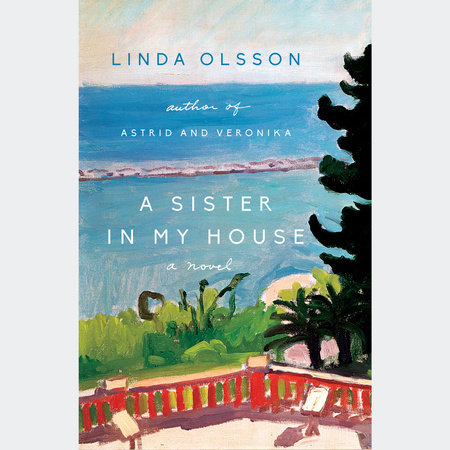
Q: A Sister in My House is set in Cadaqués, on the coast of Spain, and the town feels like its own character in the book. Why did you decide to set your novel there?
I first came to Cadaqués in 1969. I was on a summer holiday and met a Frenchman who said he wanted to take me to the most beautiful place on earth. We sailed there and I fell in love—with the place. Over the years, I have returned many times, lately more often and for longer periods. And Cadaqués has stayed remarkably unchanged. Because of its situation in a narrow bay with a backdrop of steep hills and facing the Mediterranean, it lacks space for expansion. There is simply no land for major developments or golf courses, and the modest, pebbly beach does not attract the tourists that flock to the French Riviera or the Spanish playas farther south. Although the population of some three thousand people swells tenfold during the peak summer season, it is a discrete crowd. Many come to explore the national park to the north, Cap de Creus, where the Pyrenees disappear into the Mediterranean Sea. The rich birdlife and the strange, barren landscape attract passionate birdwatchers and trackers. Then there is the legacy of Salvador Dali, which adds a surreal air to this otherwise rather serene place.
I did write A Sister in My House here, in a house much like Maria’s, which offers an ever-changing, distractingly beautiful view.
Q: Your novels are always fascinating portraits of relationships between women. Why did you decide to explore the relationship between two near-estranged sisters?
I am not sure I did decide to explore the relationship between two sisters, so much as the story somehow evolved there without my help. I come from a family with many tragic abandonments and separations, and I think all my novels deal with characters who have had such experiences in their lives. Perhaps I am just selfishly using my characters to teach myself acceptance and understanding, because my characters are often able to resolve many of their issues and find some kind of peace. The fact that Maria and Emma are sisters might emphasize the sadness of their particular separation. Sisters are often very close and able to support one another during times of difficulty in life. I am not so sure that this stereotypical picture of sisterhood is that prevalent, though, although I wish it were.
Q: Do you see yourself in either Maria or Emma, and how?
That is perhaps for those who know me well to say. But Maria was the first character to come to me and I did find it easy to understand her, though I suspect that some readers will find it more challenging to relate to her. All my characters are close to me, though, and I hope that I am able to describe them so that my readers will be able to see them as I do.
Q: When you begin to think about a novel, do you start with the characters and shape the plot around them, or the other way around?
It always begins with a character. Initially, they emerge the way people in real life do: I can see them, but I know nothing about them beyond what I can observe. Their issues slowly emerge, as in real relationships as we come to know and understand one another. I get an idea of the issues that they carry. They often surprise me when I get to know them fully. However, where to place my characters is often more difficult.
With my novel The Memory of Love, I struggled with where to place the main character, Marion. I could clearly see what she looked like and I could sense her main issues. But I could not see her in a certain place or time frame. I tried to place her somewhere in New England (I have always wanted to visit and perhaps I subconsciously thought this would give me a reason to spend time there), but it didn’t feel quite right. I tried to set her in the ’50s, but that was not right either. In the end, she found her place in the small town of Kawhia on the west coast of New Zealand.
In this new novel, Maria was a clear and strong presence in my mind from the very start. I am not sure, but she may have come to me so distinctly because I have invested a little more of myself in her than I have in my other characters. The place, too—Cadaqués on the Costa Brava in Spain—was clear from the start. I was sitting there writing, surrounded by the very landscape I was describing in the novel. But it took longer to find a way to tell Maria’s story. Initially, her sister Emma was a mere bit part, a memory from Maria’s past. But slowly she came to life and was able to provide the necessary counterpart to Maria. Emma was always there, but, just as in the novel, she took her time to gain strength and make herself heard.
When I consider a novel finished, I am filled with a sense of sadness. My characters leave to enter a new life. I am a little sad, and a little worried, too. I hope I have done them justice so that readers will be able to embrace and remember them.
Q: Which books or novelists inspire you?
There is such a wealth of wonderful literature, it’s impossible to say! And my taste keeps changing as I discover new authors. I am also acutely aware of the gaps in my knowledge of classical literature. I have been reading Turgenev lately and have again been reminded of how many of the old masters that I still have left to explore. And then there are new, wonderful books entering the world of literature all the time! The challenge of choosing is overwhelming and I wish myself at least one more reading life.
Since I started writing, I have lost some of the wonderful ability to immerse myself fully in a novel. Now I have to fight against my need to dissect the text. So I am grateful for books that restore a little of that breathless abandonment that really good fiction inspires. Such a novel is The Blue Dress by Michèle Desbordes. The slim book tells the story of the life of Camille Claudel, the brilliant assistant and mistress of the French sculptor Auguste Rodin. It has been a long time since I read something that moved me so much. And made me so envious. Simply brilliant, and very inspiring.
Q: Do you have an idea for your next novel?
Yes . . .






 QUICK VIEW