AN INTERVIEW WITH WRITER GORDON RENNIE AND EDITOR DAVID LEACH
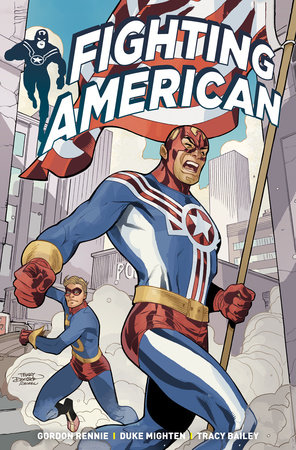
Aside from the obvious appeal of working on an original Simon & Kirby creation, what is the appeal of Fighting American for you? What makes him so special and what makes him the hero that the world needs now?
David Leach (DL): I think it’s his gung ho attitude, his punch-first – ask questions – later mentality. His utter belief in his own moral superiority. He has no guile, no inner monolog and he’s not crippled by self-doubt. He’s from that glorious era of American history when America seemed to be at its best.
Gordon Rennie (GR): What you get with Fighting American is a call-back to that earlier and more innocent era of comic book storytelling. Even if the story he’s suddenly thrust into isn’t that innocent. There’s an awful lot of downright meaness of spirit stuff in modern superhero comics, so possibly we’re commenting on that to a degree.
The Fighting American’s origin story is pretty ‘out there’ – even by Simon & Kirby standards. Have you tried to contextualise that in some way or just embraced the zaniness of it all?
GR. Oh, the character’s origin story is totally mental. We do revisit it in the story, without in any way trying to revise it, and one character does comment that allowing the military to transfer your consciousness into the physically superior body of your dead brother in order to carry on his anti-Red menace crusade might be considered a bit weird.
What have you done to preserve the unique flavor of the original Fighting American for modern audiences?
GR. He’s the same character from the 1950s, just suddenly brought into 2017. He doesn’t try to adapt himself to his new surroundings – and why should he? He thinks he comes from the greatest period in American history. We play a lot on the idea of differing perceptions between the 1950s and now, between what was normal then and what might be considered strange today. Indeed, to Fighting American, many of our social mores might seem equally odd.
The idea of the teenage sidekick is somewhat outdated now. How have you addressed that with Speedboy, and can we expect their relationship to change, going forward?
GR. Speedboy’s a lot of fun. He’s got this teenage ‘Gee whizz!’ 1950s innocence that might be slightly challenged by some of the stuff he encounters in the modern world. Supervillains and Red plots to overthrow American values he can handle, but twerking videos, building-sized lingerie billboards and online adult entertainment might be a bit tougher to deal with. Speedboy is a little more susceptible to the temptations of the 21st Century than his guardian.
Are you hoping to include other elements of the series (perhaps even other Simon & Kirby creations) during the course of your run? Any hints or teases you can provide at this stage?
GR. We’ve got a bunch of cameos from the character’s colorful rogue’s gallery of villains. It would be great to dip further into the Simon & Kirby character pool in later series.
DL. Let’s just say that the Simon & Kirby Universe is a wondrous place full of fantastic characters and that we see Fighting American as our portal into that amazing multi-dimensional universe.







 QUICK VIEW