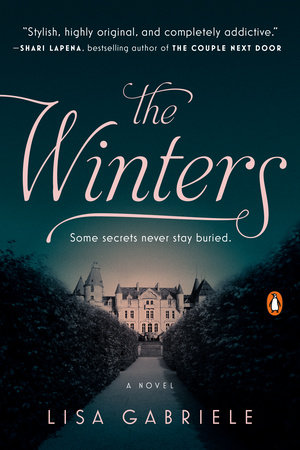
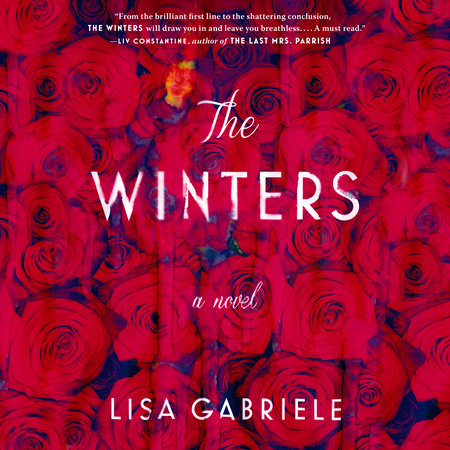
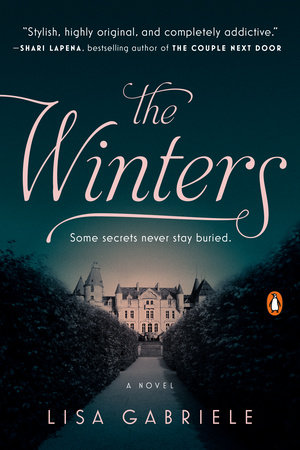
A conversation with Lisa Gabriele, author of The Winters
The Winters begins like a lot of books, with a handsome man sweeping a young woman off her feet. But at its heart, this is a story about women—our unnamed heroine, plucked out of her quiet existence; Rebekah, the dead first wife who haunts her dreams; and Dani, Rebekah’s vengeful teenage daughter. Did you set out to write a story about female relationships, power, and sexuality?
Yes. I’m obsessed with female relationships, sex, and power—and how they intersect. These are my favorite things to read and write about. The genesis of this book began with me thinking about the women in Rebecca, and all the ways modern female characters and a new setting would completely change their relationship with each other. Suddenly The Winters became an exercise in demonstrating how much women have changed in contemporary times, and how some men, especially rich and powerful ones, really have not. I mean, think about all the different ways patriarchy still shapes and molds our lives as women. My narrator certainly has agency—she has a job of her own that she’s quite good at, and is a potential role model of a single working woman—but she’s still deeply susceptible to the lure of a “happily ever after.” And with Max’s daughter, Dani, I got to play around with some of my worst fears around young women and social media, on the difficulty of getting your new boyfriend’s kid to accept you, and about feminism’s so-called generational divide.
The Winters is inspired in part by Daphne du Maurier’s classic novel Rebecca—an instant bestseller, first published in 1938, that has never gone out of print, reportedly selling 50,000 copies a year. And it’s obvious you’re a fan. What do you love about it, and what made you use it as the launching point for your novel?
Anyone who knows me knows I’m a big fan of Rebecca. My mother, who died almost twenty years ago, introduced me to Alfred Hitchcock’s movie first, and whenever I miss her I reach for it. In the fall of 2016, in the despairing days of the US election, I bought some ice cream and threw in the DVD to drown out the bad news. But this time, instead of comforted, it left me feeling deeply uneasy. I had to remind myself that in Daphne du Maurier’s book Maxim de Winter killed his sexually rebellious first wife, a fact that Hitchcock, due to Production Codes at the time, erased. I suddenly felt this strong desire to avenge Rebecca and punish Maxim. So I guess you could say nostalgia inspired me to reread the book, but anger drove me to write mine.
Much of The Winters is set at Asherley, Max Winter’s opulent estate in the Hamptons. Why did you choose that setting?
I’ve always been fascinated with Long Island’s moneyed elite; a couple of my favorite books are set there. I loved the storied Gold Coast of The Great Gatsby, and the deceptively serene town in The Amityville Horror. I needed a place that combined history and horror and the Hamptons seemed like a natural choice. However, to pull off the violent conclusion, I also needed a location that wasn’t only private but remote. In the research stage, I visited the Suffolk County Historical Society in Riverhead and read about Gardiner’s Island. It’s one of the biggest swaths of privately owned land in America, purchased by Lion Gardiner from the Montaukett Indians in the 1600s in exchange for a large black dog and some Dutch blankets. Today it’s worth more than $125 million so keeping the island in the family has driven generations of Gardiners to sometimes concoct nefarious plots. So Winter’s Island was born, as was a motive for murder.
As our narrator spends more time at Asherley and begins to discover her new family’s dark secrets, The Winters becomes a gripping slow-burn thriller. What are your tricks for building suspense and keeping the reader on the edge of their seat?
E. L. Doctorow said, “Writing a novel is like driving a car at night. You can only see as far as your headlights, but you can make the whole trip that way.” With The Winters I never set out to write a thriller. I just metaphorically made my headlights a little dimmer and the road ahead a little snakier, but kept the speed the same, (barely) avoiding smashing through the guardrails.
You’ve been a journalist and an award-winning producer, in both radio and TV, for more than twenty years. When (and how) does your journalism background seep into your novels?
I am first and foremost a journalist. The books I write require research to get the settings, tone, and era right, but it’s my favorite part of the job. My characters tend to arrive almost fully formed. So when the unnamed narrator of The Winters insisted she worked on boats, and Max decided to run for reelection in Suffolk County, I had some research to do. Learning about politics at the state level and proper boat terminology was interesting and fun. And I reached out to a PhD in mortuary archaeology to confirm how many years it would take for a body buried in a shallow grave to completely turn to skin and bones. And, thankfully, one of my best friends is a family lawyer, so I ran by her all the details about conservatorships and inheritances.
The Winters takes many of its cues from classic novels—a plain, unassuming heroine; a dashing older gentleman; a lavish estate; an inconvenient first wife. But the ending is decidedly more modern—even feminist. Without giving too much away, can you speak to how you went about crafting a contemporary version of these kinds of novels?
Writing a modern book that that still pays tribute to a beloved classic is a tricky balancing act. I am a huge fan of the ones done well: Jane Smiley’s King Lear redux, A Thousand Acres; Jean Rhys’s The Wide Sargasso Sea (which is actually a prequel to Jane Eyre, which du Maurier herself retold with Rebecca); Curtis Sittenfeld’s Eligible (a hilarious retelling of Pride and Prejudice); and Joanna Trollope’s Sense and Sensibility. The best ones preserve the original’s landmarks, though the terrain is completely different. They’re written in a contemporary style, though a sharp-eyed reader will spot my own iambic hexameter.
Finally, considering the evocative setting of The Winters, where do you think is the best place to read a book like this?
You should read The Winters at one of my favorite hotels, The Chequit Inn, on Shelter Island. You should be sitting on the deep front porch that overlooks the Peconic River sipping sweet tea.







 QUICK VIEW