



READERS GUIDE
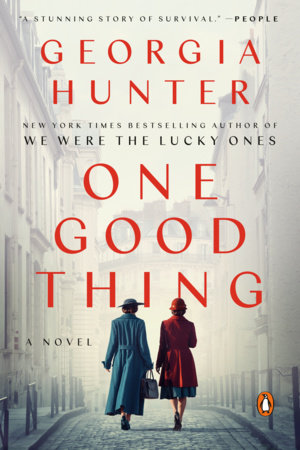
AN INTRODUCTION TO ONE GOOD THINGItaly, 1940. Lili and Esti have been best friends since they first met at university. When Esti’s son, Theo, is born, they become as close as sisters. While a war seethes across borders, life somehow goes on—until Germany invades Italy, and the friends suddenly find themselves in occupied territory.
Esti, older and fiercely self-assured, convinces Lili to join the resistance efforts. But when disaster strikes, a critically wounded Esti asks Lili to take a much bigger step: To go on the run with Theo. To protect him while Esti can’t.
Terrified to travel on her own, Lili sets out with Theo on a harrowing journey south toward Allied territory, braving Nazi-occupied villages and bombed-out cities, doing everything she can to keep the boy safe.
A remarkable tale of friendship, romance, motherhood, and survival, One Good Thing reminds us what is worth fighting for—and that love, even amid a world in ruins, can triumph.
A CONVERSATION WITH GEORGIA HUNTER
1. One Good Thing is a novel about what it was like to live through the Holocaust in Italy. This is not a common setting for World War II novels. Why did you choose it?
I was drawn to World War II Italy as a setting for a couple of reasons. First, although the country’s Jewish community is one of the oldest in Europe, its Holocaust history is relatively unknown. It wasn’t a subject I learned about in school, nor have I read many novels written on it; it felt like a void asking to be filled.
Italy is also the place I credit as the reason for my existence, thanks to the fact that my parents’ orbits first crossed in Rome in the early 1970s. Both were American. They met through the expat community, fell in love, and stayed for a combined seventeen years. I grew up hearing stories about life there—the food, the scenery, the culture (“an explosion of beauty, antiquity, personality, noise, mystery, and style,” as my mother describes it). I took the first of many trips to Italy at three. Today, even though my bucket list is never-ending, I find myself returning again and again. For as long as I can remember, Italy has held a romantic allure—I loved the idea of devoting my headspace, my heart-space, to exploring a piece of its untold history.
2. This is your second novel set during World War II. What draws you to this time in history?
The decision to unearth and record my family’s Holocaust survival story for my first novel, We Were the Lucky Ones, felt like a calling of sorts. It took me down a decade-long quest for answers and, along the way, sparked a passion, not only for the research—I got so much out of asking questions and piecing together the truth of what happened—but also for preserving a story that otherwise would have gone untold.
Part of what compels me now to write about World War II is the fact that the war, and with it the Holocaust, might soon feel like ancient history. I’ve tried, in my prose, to peel away the sepia tones, to allow the narrative to unfold in the present and in full color, so readers of all ages can relate to it in a way that feels modern, personal, and human.
3. At the center of One Good Thing is the friendship between two young women, Lili and Esti. How have your own female friendships aided and inspired the writing of One Good Thing?
We Were the Lucky Ones, at its core, is about a family bound by love. I wondered when I began writing One Good Thing if the theme of friendship would feel like a departure of sorts, like venturing down an entirely new thematic path. But Lili’s narrative, I quickly discovered, was also rooted deeply in love.
I channeled my own closest friends—the women I’d do anything for, and who would do anything for me—as I brought Lili and Esti’s relationship to life. Stepping into the shoes of my Italian protagonists was a beautiful reminder of how grateful I am for the unbreakable bond I share with my girlfriends, and of the strength and inspiration I draw from each of them.
4. As discrimination against Jewish people begins to rise in Italy, Lili and Esti differ in their reactions to it. Lili prefers keeping quiet, hoping it will blow over, while Esti believes in speaking up and fighting back. How do you hope your novel inspires people to act against modern-day injustices?
I wish Lili’s story didn’t feel so relevant. The Holocaust is an example of what can happen when people stop seeing each other as human beings, and it’s unnerving to watch similar injustices transpiring around us today.
In Lili’s journey, she heavily relies upon the help of others to eat, to hide, to survive. Her circumstances are filled with strangers (many of whom were drawn from real people) willing to put their safety, and sometimes their lives, at risk, often for no other reason than simply to do what, in their minds, feels right. Readers can take away what they will from these acts of bravery and kindness. For me, they offer hope, inspiration, and a reminder that one small act of humanity—and in contrast, one small injustice—can lead to another. That, collectively, these acts have the power to change lives, along with the course of history.
5. Motherhood is another major theme of One Good Thing—not only in the relationship between Theo and Esti, his biological mother, but also in the one between Theo and Lili. As a mother yourself, what is it like to write about a child who is growing up during this time in history?
My youngest son was barely two when I began writing One Good Thing. Being a mom to him and to his older brother (seven at the time) has been one of the most rewarding and wondrous experiences of my life. I loved spending time with Theo on the page; his character was very much inspired by my boys. The scenes were a joy to write, as I could relate to the twists and turns and milestones that come along with toddlerhood, to the simple pleasure of an afternoon spent hunting for salamanders by the pond, to the power of a well-told story to pass the time.
It was nearly impossible, of course, to fathom having to make the decisions Lili and Esti were forced to make to keep Theo safe. Putting myself in Lili’s shoes, the pressure often felt too great, the worst-case consequence of one wrong move too grave. I’ll never know what it was like to raise a child during the Holocaust, but imagining it was gut-wrenching at times and has certainly put the choices and challenges that I face as a parent today into perspective.
6. Your first novel, We Were the Lucky Ones, was adapted into a Hulu limited series and you were heavily involved in the process. How did your involvement in another creative industry, the TV industry, influence your writing of One Good Thing, if at all?
I was involved from start to finish in the television production of Were the Lucky Ones, and I loved every minute of it! In the early days, I joined the writers’ room as a consultant, where I spent five months in collaboration with the most incredible group of writers. Being a part of the adaptation process, watching our scripts come to life, felt like a masterclass in screenwriting—it was an incredible learning experience, and I’d like to think it helped to guide me in my own craft when it came to things like dialogue and pacing.
On set, I was deeply inspired by the attention to detail devoted to everything from our elaborate sets, filled with carefully sourced props, to our gorgeous costumes, often identical replicas of pieces that my family wore. The resounding message throughout the production from cast and crew was: “We just want to do your story justice.” This was the mission I carried with me as I wrote We Were the Lucky Ones, and I held it close as I wrote Lili’s story as well—I tried to set the stage for her with as much authentic detail as I could, to do justice to her, to Italy, and to the period.
7. One Good Thing is heavily researched, and you even spent weeks on the ground in Italy. Tell us more about this.
Traveling in Lili’s footsteps along her path to survival was a highlight of my research. Ferrara was a favorite stop, and a place I’d never been. I loved biking atop the city’s medieval walls, savoring a dinner of local specialties at Al Brindisi, and strolling through the old Jewish quarter. In Nonantola, I got the sense that everyone knew everyone, and when I visited Villa Emma, I pictured it overflowing with the refugee children who once hid there. In the hillside town of Assisi, where my ears grew accustomed to the toll of church bells, I stepped into the shop where Luigi Brizi printed his false IDs—it gave me chills to think of the network of people involved in his operation, of the hundreds of lives both risked and saved. In Florence I walked Lili’s route from the convent to Cardinal Dalla Costa’s residence, observing the narrow streets with their uneven cobblestones and peek-a-boo views of the red-tiled Duomo between blocks. And in Rome I stood in Piazza San Pietro to hear Pope Francis address a massive crowd, took a rest stop on the cold stone steps of the Fountain of Ponte Sisto, and ordered a heaping bowl of spaghetti carbonara at my favorite trattoria in Piazza Farnese (the dish a close second to my mother’s, made perfect by the addition of whipped egg whites).
With these impressions baked into my body and mind, I returned home with an abundance of sensory details, which I wove into Lili’s narrative.
8. Finally, what do you hope readers take away from One Good Thing?
Lili’s tale is the story of an ordinary young woman propelled into extraordinary circumstances that force her to ask: Am I capable of being a mom to Theo? Of covering such impossible distances on foot? Of trusting the stranger behind the door, the partisans in the woods, the priest at the local church? Of pressing on, day after day, with nothing but uncertainty ahead? I hope that, in traveling alongside Lili, in watching her confront—and eventually overcome—her deepest fears, readers are left with the sense that, with courage and perseverance and love, nearly anything is possible.
QUESTIONS AND TOPICS FOR DISCUSSION
About the Story
1. As Esti and Lili gaze in wonder at newborn Theo, Esti worries that it was unfair to bring a child into such an uncertain world. What would you say to a new mother in that moment? Do you think parents today might have the same concern?
2. Esti and Niko choose to be involved with the resistance, despite knowing the potential danger. Would you have done the same? Would your priorities have shifted upon becoming a parent?
3. How do you think Lili’s journey might have been changed if she hadn’t been responsible for Theo?
4. The Catholic Church looms large in this story. Pope Pius XII was Italian, and Vatican City is located within Rome. Lili and Theo receive a great deal of assistance from various members of the clergy during their journey, but Lili notes that the Pope himself “never publicly condemned the Nazi persecution” despite her belief that his influence “could have saved countless lives.” What do you make of that discrepancy? What forces do you think influenced Pope Pius XII in how he handled the Nazi persecution of Jews, especially in Italy?
5. Lili treasures her almond-blossom pendant, which her mother’s parents brought back from Jerusalem before Lili was born. Do you have a sentimental token that connects you to your heritage? What does it mean to you?
6. At the beginning of the story, Lili can’t imagine how Esti feels prepared to be a mother. By the end, Theo calls Lili “Mama”—and though she knows she could never replace Esti, she feels comfortable with the role. Do you think there’s one distinct point at which Lili starts thinking of herself as Theo’s mother?
7. Even after Lili learns that Esti may have been sent to Auschwitz, she maintains the hope that her friend could have survived somehow—and is resolute in her decision to continue searching for answers. If you were in Lili’s position, would you be able to hold on to such hope, even with the potential for crushing disappointment?
8. As Lili considers accepting Thomas’s invitation to move to America, she reflects, “For the last year and a half, every decision, every move, every measure to keep herself and Theo safe has been hers and hers alone. Is she even capable any longer of trusting her fate to someone else?” Do you think that these concerns are reasonable? If you were advising Lili in this moment, what would you say to her?
9. Lili is an ordinary woman forced to find extraordinary courage in order to continue on, day after day. How do you think she summoned such courage? Do you think you’d have been able to do what she did? At one point along her journey, Lili considers leaving Theo at a hospital, where, she rationalizes, he might be better off. How would you have grappled with the same dilemma?
About the Writing and the Reading Experience
10. Before reading this novel, did you know much about the experiences of Jews in Italy during World War II? What surprised you?
11. The Author’s Note reveals that a large number of people, places, and events in the story are true. Does this surprise you? How does knowing that a narrative is rooted in historical truths impact the messages you take away from it?
12. Most historical fiction is written in the past tense. Why do you think the author chose to write this story in the present tense? What impact, if any, did this have on your reading experience?
13. How do you feel about the author’s decision to leave Esti’s fate open-ended?
14. Why do you think the author chose One Good Thing as the title for her novel?
15. Lili’s safety often depends on the kindness of complete strangers—people willing to open their doors to her and Theo, to offer them a place to sleep and some food. Did you ever consider what you would do, should someone come to your door in search of help?