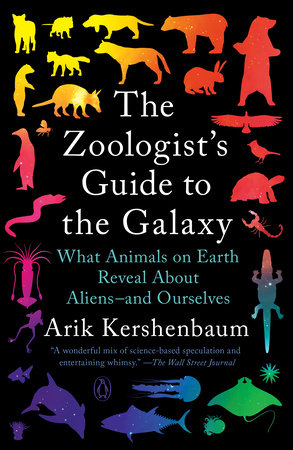
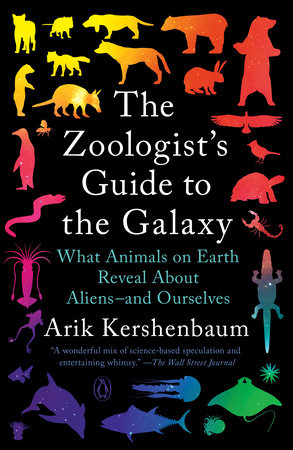
“‘Are we alone?’ In his book The Zoologist’s Guide to the Galaxy, Arik Kershenbaum takes a novel and rewarding approach to this question. . . . A wonderful mix of science-based speculation and entertaining whimsy.” —The Wall Street Journal
“Helpful definitions and explanations guide the reader through concepts such as chaos theory, natural selection, form versus function and convergent evolution. . . . Through these examples, which he mixes with humor and even references to science fiction books and films, Kershenbaum relays fascinating scientific concepts in layman’s terms. The Zoologist’s Guide to the Galaxy will appeal to anyone who ponders what life is like among the stars.” —BookPage
“In his entertaining and thought provoking The Zoologist’s Guide to the Galaxy, the Cambridge University zoologist and mathematical biologist Arik Kershenbaum provides readers with a tentative sketch of the nature of potential alien life on other potentially habitable planets.” —Science
“A highly entertaining, science-based consideration of what alien life might be like.” —Library Journal
“I hope it’s not just for the purely personal, idiosyncratic reason that he writes like me that I love The Zoologist’s Guide to the Galaxy by Arik Kershenbaum. Although it sets out to be (and is) about alien life, what emerges is a wonderfully insightful sidelong look at Earthly biology.” —Richard Dawkins, via Twitter
“Entertaining. . . . Rather than offer a fantastic version of extraterrestrial life, [Kershenbaum] gives readers something logical to consider, and in so doing provides insight on animals and humans as he explores how life, communication, and movement have evolved. . . . [S]ure to please readers looking to learn about life on other planets, or even here on Earth.” —Publishers Weekly
“Enjoyable and informative. . . . [Kershenbaum] successfully conveys tricky subjects without sacrificing clarity or letting his narrative get buried in technical discussions, and he writes with an enthusiasm that is infectious. . . . This is a fun, rewarding journey, and by the end, his analysis teaches readers as much about life on Earth as it does elsewhere.” —Kirkus
“If you don’t want to be surprised by extraterrestrial life, look no further than this lively overview of the laws of evolution that have produced life on earth. Assuming these laws to be universal, Arik Kershenbaum predicts what alien organisms might look like.” —Frans de Waal, author of Mama’s Last Hug: Animal Emotions and What They Tell Us about Ourselves
“A fun, and thoroughly biological, exploration of possible and impossible alien beings. If you’d love to know what real aliens from other planets might really be like, this is the book for you.” —Susan Blackmore, author of Seeing Myself
“Surveying the deep-time of evolution on Earth and his own cutting-edge research into animal communication, Kershenbaum provides a fascinating insight into the deepest of questions: what might an alien actually look like.” —Lewis Dartnell, author of Origins
“Evolutionary theory helps us explain patterns in the past, and combined with a rich understanding of natural history and biodiversity, predict what might be discovered in the future. Arik Kershenbaum takes us on a joyous voyage of animal diversity and illustrates the singular importance of natural selection in explaining life—here on Earth—and what will likely be discovered throughout the galaxy. A stimulating read!” —Daniel T. Blumstein, Professor of Ecology and Evolutionary Biology, University of California Los Angeles







 QUICK VIEW