“A searing indictment of judicially condoned—and even enshrined—racism in American law. . . . A powerfully argued study of a legal system that favors those who ‘persevere in undermining Black freedom.'” —Kirkus Reviews (starred review)
“Vividly narrated and astute, this is a damning reassessment of the judicial branch’s civil rights legacy.” —Publisher’s Weekly (starred review)
“Precisely outlines, within the historical context of the United States, how the Supreme Court has repeatedly and specifically denied or significantly delayed full rights of citizenship to Black people. . . . Starkey masterfully uses a unique blend of storytelling and legal documentation to share his declarations.” —Library Journal (starred review)
“Brando Simeo Starkey delivers a devastating cross-examination of the Supreme Court of the United States. . . . Starkey demolishes the myth of color-blind jurisprudence and lays bare SCOTUS’s central role in preserving caste-based inequalities in American life.” —Alta Journal
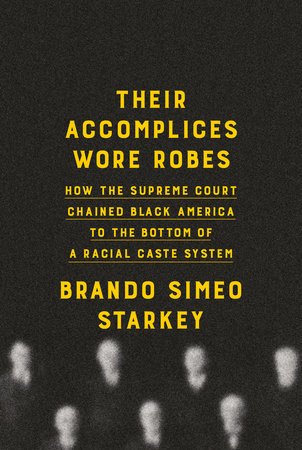
“Their Accomplices Wore Robes is a stark, measured indictment of power dressed in principle. Brando Simeo Starkey lays bare the quiet, deliberate mechanisms by which the Supreme Court has upheld a racial caste system—not as an aberration but as a feature of its design. This is not a book about what we wish to believe about justice; it is a book about what justice, in practice, has too often been. Starkey writes with clarity and precision, refusing easy conclusions or consolations. The result is an indictment of a judicial system that must be fundamentally reformed or abolished if we’re to have real democracy.” —Donovan X. Ramsey, author of When Crack Was King, finalist for the National Book Critics Circle Award, longlisted for the National Book Award
“Starkey’s book is a passionate, deeply researched, humanistic story of how African Americans have evoked the 13th, 14th and 15th Amendments as a bulwark against a racial caste system from the Jim Crow era to the present, and how their efforts have often been met with faulty reasoning, disavowals of reality, and obfuscation by a Supreme Court that has repeatedly shut its doors to their claims. Elegantly composed in a personal style that makes its stories come alive, this book is a book written to inspire reflection, disagreement, and argument – the kinds of things that are sorely needed in our own complex times.” —Kenneth W. Mack, Lawrence D. Biele Professor of Law and Affiliate Professor of History, Harvard University







 QUICK VIEW