Best Seller
Hardcover
$30.00
Available on May 26, 2026 | 304 Pages
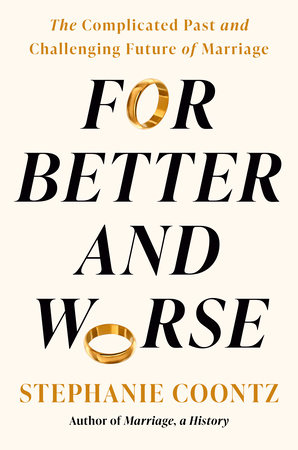
A provocative, authoritative reckoning with the past and future of marriage, explaining why it’s become more rewarding as well as riskier
Marriage rates have fallen dramatically since the 1970s. Yet far from devaluing marriage, people still overwhelmingly describe marriage as the highest commitment they can imagine. Most Americans say they want to marry eventually, and couples who do marry have a lower chance of divorce than at any time since the 1970s. Increasingly, though, people tell pollsters they “have no idea” if they actually will end up married. And unlike in the past, young women are more uncertain than young men.
In For Better and Worse, Stephanie Coontz—author of the “rich, provocative, and entertaining” book Marriage, A History—unravels the roots of such paradoxical trends. Examining five critical periods of historical transformation, she reveals how shifting romantic ideals, gender expectations, sexual mores, and cultural myths have bequeathed us a welter of contradictory beliefs, dysfunctional habits, and emotional earworms that make it hard to adjust our family relationships to the social and economic challenges of twenty-first-century life.
Coontz demonstrates that today’s widespread nostalgia for a seemingly more stable past is an understandable reaction to heightened economic insecurity and eroding social solidarities. But trying to reproduce a largely imaginary golden age of marriage from the past simply locks us into a restricted future.
Current public debates about marriage are dominated by two diametrically opposed groups. One argues that marriage is the only sure route to personal happiness and social stability; the other, that marriage is inherently oppressive. Coontz puts forward a radical middle ground, pointing to surprising new research on the personal changes and the policy innovations that can help people create successful relationships, in or out of marriage.
Marriage rates have fallen dramatically since the 1970s. Yet far from devaluing marriage, people still overwhelmingly describe marriage as the highest commitment they can imagine. Most Americans say they want to marry eventually, and couples who do marry have a lower chance of divorce than at any time since the 1970s. Increasingly, though, people tell pollsters they “have no idea” if they actually will end up married. And unlike in the past, young women are more uncertain than young men.
In For Better and Worse, Stephanie Coontz—author of the “rich, provocative, and entertaining” book Marriage, A History—unravels the roots of such paradoxical trends. Examining five critical periods of historical transformation, she reveals how shifting romantic ideals, gender expectations, sexual mores, and cultural myths have bequeathed us a welter of contradictory beliefs, dysfunctional habits, and emotional earworms that make it hard to adjust our family relationships to the social and economic challenges of twenty-first-century life.
Coontz demonstrates that today’s widespread nostalgia for a seemingly more stable past is an understandable reaction to heightened economic insecurity and eroding social solidarities. But trying to reproduce a largely imaginary golden age of marriage from the past simply locks us into a restricted future.
Current public debates about marriage are dominated by two diametrically opposed groups. One argues that marriage is the only sure route to personal happiness and social stability; the other, that marriage is inherently oppressive. Coontz puts forward a radical middle ground, pointing to surprising new research on the personal changes and the policy innovations that can help people create successful relationships, in or out of marriage.

Author
Stephanie Coontz
Stephanie Coontz is the director of research and public education for the Council on Contemporary Families. She has authored five books on gender, family, and history, including Marriage, a History: How Love Conquered Marriage, which was cited in the United States Supreme Court decision on marriage equality. A sought-after radio and podcast guest, she has published extensively in both academic and popular media, from The New York Times, CNN, and The Wall Street Journal to The Chronicle of Higher Education and the Journal of Marriage and Family.
Learn More about Stephanie CoontzYou May Also Like
Having People Over
Hardcover
$30.00
A Little More Social
Hardcover
$32.00
You Can Count on Me
Paperback
$16.00
Bonded by Evolution
Hardcover
$32.00
Painting Below Zero
Hardcover
$50.00
The Alchemy Journal
Hardcover
$19.99
A Proust Questionnaire
Paperback
$18.00
Scriptnotes
Hardcover
$32.00
Blue Rose
Paperback
$18.00
×