TEACHING GUIDE
DISCUSSION AND WRITING1. Members of the Bucci family were very close, and yet the girls’ Catholic grandmother’s family in Istria refused to help them. Why do you think that is? What does this tell us about family dynamics in general and about Italian society under Fascism?
2. Why did the Buccis stay in Fiume even as their family members and neighbors hid or fled? How did the chaos of the war and their father’s incarceration in South Africa affect their understanding of what was happening and influence their choices?
3. In the end it was the women and children of the Bucci family who were deported to Auschwitz-Birkenau. How does this put into relief or challenge established gender roles in families at the time? How does Mira’s maternal love intersect with her survival instinct? How do the routines she created for the girls before the war help them while they were in Birkenau and afterward? How does the girls’ relationship with their mother transform over the course of the memoir? How does it stay the same?
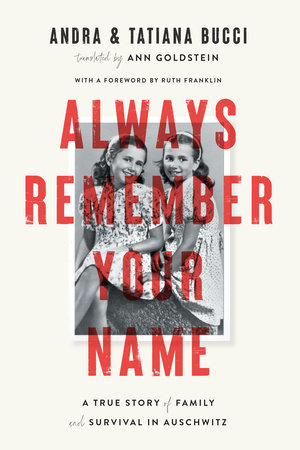
4. The photograph of Tati and Andra’s parents on their bedside table in Fiume plays a key role in their reunion. The sisters’ father is absent for much of the narrative but still looms large. What role does his absence play in the girls’ ordeal? How might things have been different had he been home with them during the war?
5. The sisters’ cousin Sergio comes to a tragic end in spite of their effort to warn him. What do you think moved him to believe the guards’ lie? What role does chance play in a life-and- death situation like this?
6. This is a very rare testimony of children who survived Auschwitz. In the memoir, the children didn’t always seem fully aware of what was happening at the camp, or why they were there, and yet they saw the horrors and suffered tremendously. How do the authors’ young ages make this memoir different from other Holocaust memoirs? How did their youth shape the impact the horrors had on them?
7. How does the fact that the memoir is in two voices—at times speaking as one, at times in conversation—affect the reading experience? How is the strong bond between the sisters reflected in these pages and how is it reflected in the fact of their survival?
8. In some ways, this account picks up where Anne Frank’s diary left off. Very few children survived Auschwitz, but the Bucci sisters were
among them. Some of the things that seem most likely to have increased Tati and Andra’s chances for survival (having each other, their
mother’s presence) were also true of Anne, who was in Auschwitz together with her older sister, Margot, and their mother. But Anne was treated as an adult in Auschwitz, required to work, while the younger children weren’t. Can you think of other literature about the Holocaust that discusses the arbitrariness of survival in the camps? What possible explanations do Primo Levi, Elie Wiesel, or others give for the miracle
of their survival?