




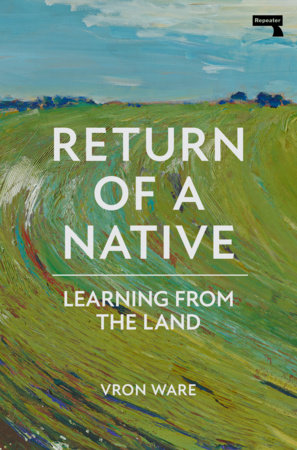

From a fixed point in the middle of English nowhere, Vron Ware takes you through time and space to explain why transcending the urban-rural divide is integral to the future of the planet.
Rural England is a mythic space, a complex canvas on which people from many different backgrounds project all kinds of fantasies, prejudices, desires and fears. This book seeks to challenge many of these ideas, showing how the artificial divide between rural and urban works to conceal the underlying relationship between these two fundamental poles of human settlement.
This investigation of rurality is oriented from a fixed point in north-west Hampshire, marked by a signpost that points in four directions to two towns, four villages and two hamlets. Through stories, interviews and reportage gathered over two decades, the book demolishes tired notions of rural England that cast it as a separate realm of existence, whether marooned in a perpetual time-warp, or reduced to a refuge for the retired, wealthy urbanites, extreme nature-lovers, and, more recently, anyone tired of waiting out the pandemic in towns and cities. It poses two simple questions: what does the word rural mean today? What will it mean tomorrow?
The author is an ambivalent native, held captive to the land by an umbilical cord but always on the verge of fleeing home to the city. She writes from a feminist, postcolonial standpoint that is alert to the slow violence of historical processes taking place over many centuries; enslavement, colonialism, industrialisation, globalisation. Both argument and narrative are propelled by the urgent need to reconsider the concept of ‘countryside’ in the context of the climate emergency and the patent collapse of ecosystems due to intensive farming which has poisoned the land.
Rural England is a mythic space, a complex canvas on which people from many different backgrounds project all kinds of fantasies, prejudices, desires and fears. This book seeks to challenge many of these ideas, showing how the artificial divide between rural and urban works to conceal the underlying relationship between these two fundamental poles of human settlement.
This investigation of rurality is oriented from a fixed point in north-west Hampshire, marked by a signpost that points in four directions to two towns, four villages and two hamlets. Through stories, interviews and reportage gathered over two decades, the book demolishes tired notions of rural England that cast it as a separate realm of existence, whether marooned in a perpetual time-warp, or reduced to a refuge for the retired, wealthy urbanites, extreme nature-lovers, and, more recently, anyone tired of waiting out the pandemic in towns and cities. It poses two simple questions: what does the word rural mean today? What will it mean tomorrow?
The author is an ambivalent native, held captive to the land by an umbilical cord but always on the verge of fleeing home to the city. She writes from a feminist, postcolonial standpoint that is alert to the slow violence of historical processes taking place over many centuries; enslavement, colonialism, industrialisation, globalisation. Both argument and narrative are propelled by the urgent need to reconsider the concept of ‘countryside’ in the context of the climate emergency and the patent collapse of ecosystems due to intensive farming which has poisoned the land.
You May Also Like
 QUICK VIEW
Chain of Ideas
Hardcover
$35.00
QUICK VIEW
Born at the Gates of Hell
Trade Paperback Original
$19.95
QUICK VIEW

Washington Is Burning
Hardcover
$29.95
QUICK VIEW

Electric Life
Trade Paperback Original
$40.00
QUICK VIEW
The Credibility Crisis in Science
Trade Paperback Original
$40.00
QUICK VIEW
Reclaiming the Internet
Unabridged Audiobook Download
$15.00
QUICK VIEW
The General Theory of Employment, Interest and Money
Trade Paperback Original
$17.95
QUICK VIEW
The Echo Machine
Trade Paperback
$16.95
QUICK VIEW
An Abundance of Caution
Trade Paperback
$29.95
QUICK VIEW
A Scandal in Königsberg
Hardcover
$27.00


×