


Under the Banner of King Death Reader’s Guide
By David Lester Marcus Rediker
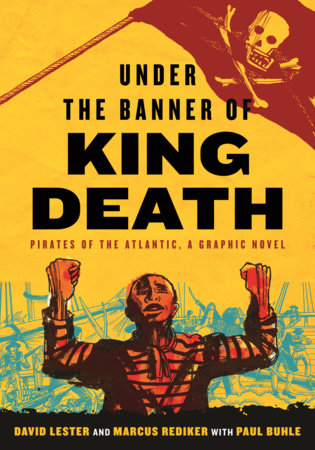



1. Under the Banner of King Death begins with John Gwin’s and Ruben Dekker’s compatriot Brownie on the gallows, railing against the conditions of work for honest sailors, which moved him to turn him pirate. While mourning their friend over ales, both survivors are then sold into servitude on the slave ship African Prince. Based on Brownie’s declarations about conditions and treatment aboard non-pirate ships, do you think the type of kidnapping experienced by John and Ruben was a frequent occurrence, since men might not voluntarily join crews?
2. Ruben and John make a formal complaint to the Royal Africa Company about conditions and treatment aboard the ship. While they are found out and then punished for daring to do this, would their complaints have made a difference? Historically, how widespread do you imagine poor conditions and treatment to have been on ships at that time?
3. After disembarking in Port Royal, before any real planning of a mutiny, the Prince’s crew did not simply disappear or find means to escape and instead returned to the ship. Why?
4. Once John and the crew overthrew the ship’s captain and decided to “go upon the account,” they plundered a Dutch ship, overpowering the crew with ease and without bloodshed. Historically, would a bloodless plundering have been a regular occurrence? Why or why not?
5. Mark revealed herself as Mary to John after the crew captured treasures from the Dutch ship. Considering Mary was a newer member of the crew, even if one of its informal leaders, why do you think she revealed herself to him rather than to the common pirates? Would it have made a difference to her shipmates if she told them earlier since her reputation was already established?
6. Would it have been difficult for John and Mary to hide their relationship from the other crew? Why or why not?
7. While the pirates on the Night Rambler practiced some form of democracy, when Captain Snelgrave was delivered to the ship, the testimony of only one man spared his life. That crewmember stated that when sailing with Snelgrave years before, he found Snelgrave to be an honest captain who treated his crew well. What may have changed with Snelgrave that led him to be the cruel captain who those on the African Prince/Night Rambler encountered? And why do you think the testimony of the lone crewmember wasn’t overridden by a majority in favor of well-deserved “pirate justice”?
8. Is it any surprise that Captain Snelgrave didn’t afford the captured pirates the same mercy that he was given? Why or why not? Was it foolish of the crew to keep him alive, or could there have been another motive for them sparing his life rather than just mercy?
9. Mary was spared hanging until after she gave birth to her and John’s child. What could have happened to that child? Is it a surprise that, as a woman of the time, Mary wasn’t granted leniency, despite being a pirate?
10. The story of John Gwin and his crew takes place during the “Golden Age” of piracy, which lasted from about 1660 to 1730 and which Marcus Rediker discusses in his foreword. While not as prevalent in the West, piracy still exists today. How might the life of a modern-day pirate compare to that of one in the “Golden Age”?
11. In his afterword, “Pirates We Have Seen: Footnotes from Popular Culture History,” Paul Buhle discusses how pirates were depicted by artists during the first decades of the Golden Age of piracy. Does their visual evolution over time from “gent” to rascal surprise you? If so, why?
12. Under the Banner of King Death is a graphic adaption of Marcus Rediker’s nonfiction work Villains of All Nations: Atlantic Pirates in the Golden Age. Does a graphic novel provide a better glimpse into the life of pirates than a standard nonfiction book? Why or why not? Do David Lester’s illustrations reinforce or change your notion of pirates and the lives they led? How does a graphic novel enrich your understanding of history compared to a traditional prose book?