



READERS GUIDE
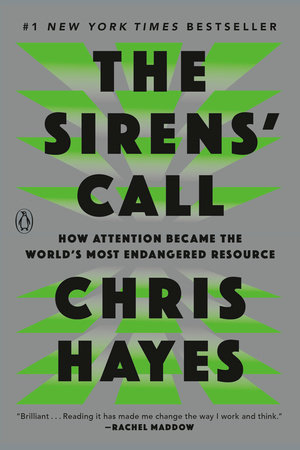
The questions, discussion topics, and other material that follow are intended to enhance your group’s conversation of Chris Hayes’s The Sirens’ Call, a fascinating analysis of the psychology of attention and how the evolution of media is shaping our ability to access and use this vital, humanizing resource. Hayes combines riveting firsthand accounts from his career as a newscaster with key turning points in history and culture to pose an urgent call to action to reframe our relationship with technology and channel our inner Odysseus, saving ourselves from the storied fate of the sailors in Greek mythology who were lured by the fatally beautiful call of the sirens.1. Describe your relationship with attention—your own and the concept in general—before and after reading this book. What value did you ascribe to it, and how did you consider it as a resource in your life and your sense of self? Were you aware of things that drained, distracted, or preyed on your attention? What prevents you from understanding the limits of attention in your day-to-day experience, despite any real and obvious biological signs that the brain can only take in so much? Discuss the rise and state of the attention economy in terms of supply and demand in the information age.
2. How did you feel when learning about the unconscious, sensory-based ways that our involuntary attention can be grabbed by the outside? Do the realities of that neurology—part of what makes us human—align with narratives about controlling one’s attention through sheer will power or morality? How might the science of attention shift how you personally engage with technology and/or where you locate the root cause of the distracting, alluring pull of technology on your mind?
3. Hayes states that “the most powerful attention miners of our age don’t need to take all our attention all the time, just a few seconds here and there again and again” (53). How have you experienced—physically, mentally, and socially—the cumulative effects of the platforms’ “hail, grab, hold” method of extracting the value of your attention piecemeal (57)?
4. Hayes makes the succinct, bald statement that “[social media] platforms regulate attention to keep your attention on the platform. There is no purpose other than that. That is their value proposition” (220). While this truth is in the public discourse, not many people think about this when they engage on the platforms. Has reading a whole book about this cornerstone of their business model factored into your use of them? Is it surprising to you that this business model—the exchange of attention alone, with no message/content that follows—even works?
5. Well before the information age, countless lineages, cultures, and traditions have noted an innate human dissatisfaction from being with our own thoughts: the “terror of our own uninterrupted minds” (59). Did the stories of what people have done to avoid isolation surprise you? If this is a fairly baseline state for the human psyche, what does this say about our future? Even if modifications and restrictions are made around technology and social media, would we find other, equally horrifying, and ultimately self-destructive, ways to escape that terror? What might those look like? Do you imagine a hopeful or discouraging outlook for society in this regard?
6. What activities/relationships do you seek out when you feel isolated or alone? Have you thought about those coping mechanisms (conscious or unconscious) differently since learning more about human evolution and the tribal nature of society and the mind?
7. Is there a plateau on the utility of certain technologies, or all technology? Discuss how other innovations, like those in transportation, have made huge improvements in their first few decades of existence, then tapered off. How are the changes in tech similar to or different from cars or airplanes, for example, and how does the race for attention expand the ways in which technology can become stronger?
8. Hayes alludes to the classic play Death of a Salesman to illustrate the potential outcome of a world in which attention is either not paid to people, or not followed up with genuine care. What do the Willy Lomans of the twenty-first century look like? Discuss his death by disregard in the context of the former U.S. surgeon general’s mission against the epidemic of loneliness, and other ramifications of our digital times and distorted engagement of social attention.
9. Reflect on your own relationships and how you define, give, and receive social attention versus care. How far have you gone to satisfy your needs, or someone else’s needs, for social attention, and was that mutually beneficial? Where do your investments in social attention pay off—for you and/or for others—and where do you feel like the balance is uneven?
10. Hayes cites and analyzes the well-known historical example of the Lincoln-Douglas debates as a point of contrast for our modern-day political (and general) discourse. Are there any spaces left that rely on complex thought and sustained attention? What would have to happen to return to that style of thinking and communicating? Consider the related concept from Marshall McLuhan: “the medium is the message.” What are the messages of our current mediums?
11. At the time of the Lincoln-Douglas debates, and other social contexts like school classrooms, an “attentional regime” (216) is required to maintain order such that productive conversation and communication can take place. How would you describe the “attentional regime” of our times, and of the internet more broadly? Does your family, workplace, or community abide by rules that facilitate cooperation, and/or have those regimes changed over time with the increase in technology? What effects have you seen?
12. Being the subject of attention is part of the job for public figures, but as Hayes describes it’s not a one-size-fits-all situation—a pop star and a politician may wield their power to garner attention differently. “Only the neediest, most psychologically compromised people with actual power or wealth pursue [attention], because the more stable ones understand that it’s actually not that valuable a resource, its apparent desirability notwithstanding,” he writes (191). Discuss some public figures to whom you give your attention, those who seek out your attention, and those who remain relatively private/unknown. How does this relationship with attention affect their ability to do their job? How does it affect their “success,” their celebrity, and their contributions to society? Besides attention, what other factors make them more or less successful, or admirable?
13. Hayes cites Donald Trump and Elon Musk as extreme examples of attention-seeking in our present-day culture. What do their stories and behaviors reveal about the relationship between attention and happiness, or attention and success? Where do they sacrifice meaningful information for attention, and how are they serving as cautionary tales of the cost of that sacrifice? Who is paying that cost?
14. As a longtime newscaster, Hayes reflects on the decisions made in the newsroom about what to cover and for how long, saying “there is no referee to appeal to, no fixed group of judges that determine where [attention] should go” (240). What if there were a referee or group of judges monitoring attentional choices? How would that infringe upon, or support, the ideals and doctrines of American democracy? What factors do you think such a committee would base their decisions about what’s worthy of our attention in the news, or elsewhere online? Is there a specific topic you believe more people should pay attention to?
15.Pope Pius XII said in 1950: “It is not an exaggeration to say that the future of modern society and the stability of its inner life depend in large part on the maintenance of an equilibrium between the strength of the techniques of communication and the capacity of the individual’s own reaction” (19). What are the variables of this equation—communication techniques + individual reaction = stability of inner life—today, over seventy years later? How does this perspective shift the emphasis placed on self-help and individual willpower to preserve one’s attention? Besides the suggestions Hayes offers in the book, how do you think we can improve the stability of our inner lives by managing communication itself? Is the “stability of [our] inner life” even valued anymore, and what might be the tipping point to make us remember its value?
16. If you were Odysseus sailing past the sirens, do you think you’d plug your own ears like the other sailors, or would you also want to hear the sirens’ call—even if it meant risking your life? In what ways are you already making Odysseus’s choice to hear our modern “sirens”? Is what you hear as pleasurable as you thought it would be?