


READERS GUIDE
Questions and Topics for Discussion
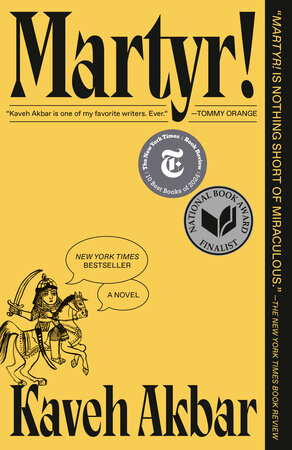
1. Both Cyrus, the protagonist of the novel, and the author, Kaveh Akbar, display their skills as poets and crafters of language. How did their attention to words inform your connection to Cyrus, as well as his Book of Martyrs project documented throughout the novel?
2. How did you pronounce Cyrus’s name while reading? How does his name itself reflect Cyrus’s quest to be understood for who he truly is, rather than impositions from cultures and identities that aren’t his?
3. Various voices occupy this novel and offer facets of perspective on Cyrus’s journey and memories. All but his own are in first person (Cyrus’s narrative is in third person). What does this suggest about Cyrus’s prominence in the narrative? Why do you think the author chose to share Cyrus’s point of view from an outside and more objective stance? How well does Cyrus know himself?
4. What personality traits are reflected in the job Cyrus has at the start of the book—as a medical actor? How do these traits show up elsewhere in his life, his own artistic pursuits, and his relationships? Can you imagine how it might feel to “play” at being sick and not fully heard by medical professionals? Might that repeated, albeit dramatized, suffering be contributing to Cyrus’s mental state?
5. What did you make of the various “cameos” that appear throughout the novel in Cyrus’s dreams? How do they guide him through the ups and downs of his struggles, and how do they add texture to the novel’s narrative itself? From which dream character did you learn the most?
6. Discuss Cyrus’s relationship with—and separation from—his father. How is Ali’s plight similar to that of many other immigrants and refugees around the world? What freedoms and what burdens did Ali’s choice to move to America impart to Cyrus?
7. How does the family’s ongoing, albeit infrequent, connection to Arash preserve Roya’s memory while Cyrus is growing up? What mark does Arash himself make on history through his role in the war? Is he a martyr—even while living?
8. Was Roya’s decision to switch her papers with Leila a worthwhile sacrifice in the end? What freedoms and losses did she incur once her history was erased?
9. Discuss Cyrus’s relationship with Zee. What holds Cyrus back from committing more fully to Zee emotionally and sexually? Do you think any of his withholding/reluctance comes from an inheritance of what his mother went through with Leila, and their inability to express their love? How does the novel challenge the mainstream notions and forms of love?
10. Discuss the moments of joy and levity in the novel. How does Akbar interweave a range of emotions into a fairly grave topic? Were you surprised to find yourself laughing while reading?
11. Have you or anyone close to you ever struggled with addiction? Discuss Cyrus’s descriptions of the need to get high and what he learns from sobriety, including: “Why would anyone choose feeling shitty when feeling good was an option?” (p. 55); and “In Cyrus’s active addiction it had taken dread and doom bringing him to his knees, or euphoric physical ecstasy elevating him half-literally out of his body—to break through his dense numb fugue . . . Cyrus was beginning to realize that the world didn’t actually work this way, that sometimes epiphany was as subtle as a friend showing you something they saw on Twitter” (p. 81).
12. Cyrus describes wanting to be on “‘the right side of history’ . . . he wanted other people to perceive him as someone who cared about being on the right side of history”; and to overcome the stereotype Orkideh imposes on him as “another death-obsessed Iranian man” (p. 126). Why does he think he’s on the “wrong” side of history? Who put him there? What history is he trying to reclaim for his mothe —and the life he missed out on when she was presumed dead—through his work and his life?
13. Discuss the histories relayed in the novel—the ancient clay tablet describing “substandard” copper (pp. 110–11) and Ferdowsi’s epic poem for King Mahmud, and the bridge built from its payment (p. 188). How do these examples complicate the meaning and significance of art and artifacts?
14. Do you believe there needs to be a fundamental trauma or darkness in a person for them to make meaningful art? How do the artists in the novel support or defy this stereotype? Consider what Roya says about her first pieces when she is in America: “I killed myself. I killed my love. I forced myself to forget my husband, my brother. My country. My son. It’s easy for people who have sacrificed nothing to rationalize their own ordinariness by calling me lucky. But I sacrificed my entire life; I sold it to the abyss. And the abyss gave me art” (p. 291).
15. If you were to make a piece of art out of or around your death, what form would it take? What aspects of yourself and your perspective would you want to continue after you weregone? Have you been able to hold on to people you’ve lost through “art,” both formal and informal—things they made, they cherished, they gifted you, or that remind you of them?
16. Did you suspect that Orkideh was really Roya all along? If so, what details helped you make the connection? Do you think Cyrus also suspected as much, even if subconsciously?
17. Cyrus begins his martyr project by wanting to fit his mother’s death into some category; her death was “without meaning . . . Not even tragic, you know? So was she a martyr?” he asks (p. 75). As an opening to his manuscript, he writes, “I am setting out to write a book of elegies for people I’ve never met. Yes, there is an unforgivable hubris in my imagining any part of their living, and presuming to write about it. There is also hubris in writing about anything else” (p. 106). How does his definition of “martyr,” and the nature of his project, change over the course of the novel? Who in the book deserves this distinction? By the end, does it seem like a badge of honor or condemnation? What does Cyrus think about martyrdom, given what he learns about his mother’s non-death does it nullify his entire question?
18. What do you think happened to Cyrus’s manuscript? How does his project compare with his mother’s oeuvre and artistic mission when it comes to collective memory, personal confession, and catharsis? What does she teach him about the medium in which art has its greatest effects?
19. Do you think Cyrus forgives his mother? Why or why not?
20. What closure do Sang and Cyrus give each other about Roya’s identity after she dies (the second time)? Is her death a mercy to them or a tragedy? Have you ever been surprised to learn a truth about someone you knew and loved after they’d died—and what did you have to do to process that information without them being present?