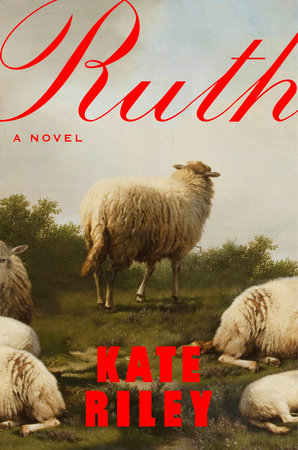
Praise for Ruth
“A touching tale of a radical experiment in living. . .Riley’s deft prose has surprising angles and hidden spikes.”—Financial Times
“A wonderful, loving, tenderly teasing and often moving portrait. . . .Riley achieves a balance of warmth and subtle hilarity in recounting Ruth’s many slips from the ‘tightrope of obedience’ . . . [a] standout.” —Wall Street Journal
“There are inklings of greatness in Kate Riley’s first novel, Ruth. It claims a place on that high modern shelf next to the offbeat books of Ottessa Moshfegh, Sheila Heti, Elif Batuman and Nell Zink — those possessors of wrinkled comic sensibilities rooted in pain…Ruth is in touch with the oldest and darkest things in our makeup, yet revels in a very modern sense of what Riley calls ‘brainy female despair.’ Under Riley’s author photograph, on the back flap, a sentence reads: ‘This is her last book.’ I hope that’s not so.”—Dwight Garner, The New York Times
“What really interests Riley is how a bright child’s mind resists the nonsensical demands of theology and how a young woman’s wit chafes in a closed community. … The author’s wry voice never flattens the meringue tips of Ruth’s childlike wonder. And later, as Ruth feels increasingly cramped in the little church, Riley maintains ironic distance, careful to avoid collapsing into the character inspired by her own experience. Her epigraphic style, informed by decades of sermons, aphorisms and comic retorts, ensures the novel’s delightful buoyancy. … Ruth’s … thwarted ambitions, her sacrifices for family and church, compose a melody as familiar as a melancholy old hymn. Riley’s ability to plumb that slip of salvation — in a way that stays true to Ruth’s life — is just one of this novel’s many graces.”—Ron Charles, Washington Post
“Utterly iconoclastic in style and tone. . .Each small section is a meditation, maybe even a prayer, albeit often a flabbergasted prayer. . .Though Ruth is filled with. . .wondrously funny passages that tip the absurd side of the scale, it manages to convey deep respect. . .Written with reverence, not only for the written word but for people who seek to lose themselves in love for others.” —The Commonweal
“Ruth is a granular portrait of a truly collective place that sometimes reads like a sidelong assessment of our lonely, technologically fractured time. . .Like the best novels of everyday life, it’s strikingly ambivalent, folding in all the moral unclarity and dissatisfaction that even people who pray, sing, and labor without complaint might feel on a Tuesday morning. . . It’s unlike anything I’ve read in a long time.” —The Cut
“A generous coming-of-age story. . .Its constant vacillation between droll superiority and unabashed earnestness makes it hard for the reader to determine whether they know better than the characters or if, in fact, they have quite a lot to learn from them. . . .Riley’s great trick is to tap into the anodyne, to make Ruth a woman whose concerns. . . are essentially universal.”—The Atlantic
“What a strange and wonderful book this is — emphasis on the strange. No, wait — emphasis on the wonderful.”—Minneapolis Star Tribune
“Riley’s wonderful debut follows a woman at odds with the Christian commune she was born into. … She never loses sight of the characters’ humanity and spiritual searching, and she adeptly explores how faith and love can be sustained. It’s a remarkable achievement.” –Publishers Weekly, STARRED review
“Riley’s first novel fascinates with its realistic depiction of Hutterite life and beliefs and the extraordinary narration of Ruth’s rich and idiosyncratic inner life from childhood to parenthood.”—Booklist
“Cheeky, inquisitive, and a delightful pain in the neck, Ruth carries the novel with aplomb. . . A charming deep dive into the life and faith of one devout yet contrary everywoman.”—Kirkus, STARRED review
“Riley’s narrator is part wry anthropologist, part reluctant memoirist. Hers is very different from the kind of candour we have become accustomed to in contemporary fiction: it’s essentially withholding, and the emotional payoff is to be found not in the explicit excavation of trauma, but in bittersweet moments of levity and flights of whimsy … Literary culture has become so mired in therapeutic discourse that we’ve almost forgotten there are other, subtler ways to explore pain.”—The Guardian
“Irresistibly smart and funny.” —Jenny Offill, author of Weather and Dept. of Speculation
“The serenely weird testament of an unintentional heroine in an intentional community, and an act of novelistic grace that deserves not only cult status but its own religion.” —Joshua Cohen, author of the Pulitzer Prize–winning The Netanyahus
“A detailed, delicate study of how character is formed by collision with so many sharp corners that they form a perfect circle – how we entrap ourselves in the choices of others, glimpsing freedom in flashes.” —Nell Zink, author of Mislaid and Doxology






 QUICK VIEW