



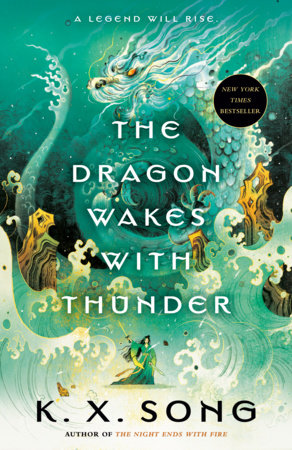
READERS GUIDE
Reader’s GuideThe Dragon Wakes with Thunder by K.X. Song
Discussion Questions:
1. At the start of the novel, Meilin is isolated—both physically and emotionally. How have the aftermath of war and the weight of betrayal shaped her sense of self? In what ways does her trauma affect how she navigates both old relationships and new ones?
2. The idea of legacy recurs throughout the novel—Meilin’s fear of becoming a stain in the annals of history, her mother’s hidden past, the dragon’s centuries-long game. How do characters grapple with the version of their story that will be remembered?
3. As Qinglong slowly begins to take control of her body, Meilin retreats inward, trying to manage her fear and confusion alone. How does this instinct serve her—or fail her? Have you seen this pattern in real life?
4. When Meilin tells the story of the Sun Daughter (page 167), Sky reveals he’s heard a different version—one that ends happily rather than tragically. Why do stories evolve with each retelling? What might the differences between Meilin’s and Sky’s versions reveal about their worldviews—or the contexts that shaped them? Can you think of real-world fables or legends that have multiple interpretations?
5. When Meilin complains to Winter about Sky’s stubbornness, Winter responds: “My brother’s gift, as frustrating as it may be, is his propensity to hope.” How does Sky’s relentless optimism shape the choices he makes—and those of the people around him? When is it a source of strength—and when is it a burden?
6. Meilin gains much through her rise to power—but what does she lose? Which parts of herself are mourned, and which are forgotten? What qualities did she once cherish that she now no longer possesses?
7. When Kuro shares his vision of a world without class, title, or bloodlines, Meilin finds it compelling—but she’s weary of war. Still, Kuro
says: “Everyone wants change, but no one wants to pay the price of revolution.” Do you agree with him? Does meaningful change always require sacrifice—and if so, who pays the price?
8. Reflecting on Lei’s quiet acts of kindness, Meilin thinks: “Everyone marked him as a monster, but what if he was one of the most selfless people I knew?” Why do you think Lei worked so hard to hide his compassion? Is it a mask born from insecurity, survival, or something else?
9. Sky and Lei remain foils to each other in Meilin’s life, each offering her different visions of the future. What do these contrasting relationships reveal about Meilin’s inner conflict? Do you think her connection to them is more about love—or survival?
10. After realizing that not all spirits are like Qinglong, Meilin begins to question whether spirits—like humans—are not inherently good or evil, but simply unpredictable. While Meilin chooses to accept a spirit’s bargain, Winter walks away. If faced with the same decision, what would you do? What kind of person does it take to say yes—or no?
11. Meilin often feels the sharp contrast between what the world demands from women—reticence, obedience, grace—and what she herself is: defiant, fractured, and full of longing. How do other female characters in the story (Meilin’s mother, Ruihua, or even Yifeng) embody or subvert these expectations?
12. When Meilin believes she ruins everything good in her life, Lei tells her, “We’re more than our worst moments. It’s our best moments that have the power to define us.” What are some of Meilin’s best and worst moments, and which do you believe ultimately define her?