
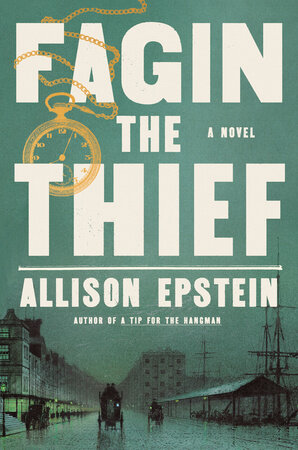
Fagin the Thief Reader’s Guide
By Allison Epstein



1. Have you read the inspiration for this novel, Charles Dickens’s classic Oliver Twist? If so, how did this expansion and revision of Jacob’s character affect your opinion of Oliver’s story? If not, were you inspired to read it (or experience any of its many adaptations)? Consider Epstein’s author’s note, especially her reminder that “no demographic is a reliable shorthand for what a person believes. The only way to find out is if you ask and listen” (p. 321).
2. How does Jacob engage with various aspects of his Jewish faith and culture throughout his life? Discuss the prejudices imposed on him by his contemporaries, as well as the belief system he develops during his life that’s illustrated through his actions. What might his mother say in response to Leftwich’s theory that “we’re living on borrowed time . . . [so] steal as much more as we can” (p. 51)?
3. Discuss Jacob’s relationship with his mother, and how their differing opinions of what it means to support and raise a family shape Jacob’s ongoing work as a thief and caretaker.
4. What draws Jacob to Leftwich—as a teacher and quasi-father figure? When they meet again years later, both older men, how does Jacob compare his trajectory with his teacher’s?
5. What is Oliver Twist’s role in this novel and in Jacob’s life? How does his appearance at Jacob’s door shift the course of the novel? Does his characterization here resemble how Dickens portrayed him?
6. How would you describe Jacob’s job and/or responsibilities? Consider how he becomes a legend among needy children: “The children who come now need him. They choose him, they seek him out, and were it the other way around, he would no longer quite know himself” (p. 245).
7. Why do you think Jacob chooses to take Bill in? Do you think that Jacob sensed how their relationship would end, if not in the specific details, then in the way they sacrifice for and condemn each other?
8. As Bill ages, his wild side becomes more and more apparent—to society and to Jacob himself. Did Jacob teach him this, or is it in Bill’s nature? Do you think Jacob could have done anything to change Bill’s fate?
9. How do fathers support their sons in the novel—or not? Discuss Jacob’s imagined conversations with his father’s ghost, as well as the scene in which Bill is confronted by his father in the bar (p. 150).
10. Were you surprised by how Jacob’s last encounter with his father turned out? What understanding do they finally come to once Jacob tells him[DW1] , “I decided years ago I wouldn’t be you, I wouldn’t be the fool who got caught, I would play their game better than any of them and I would win. You don’t know how hard I tried,” and the ghost responds with[DW2] , “Who . . . could understand that better than I?” (p. 275)?
11. Discuss Jacob’s hesitation in taking in Maggie as a student—is it due to her being a girl, or because she’s May’s daughter, or another reason? How does this relationship carry forward to the work he does with Nan?
12. Even though traditional mores dominated in this period of history, do traditional family structures—parents, children—provide the support most believe them to? What kind of family does Jacob create for himself once he is orphaned, after which the government provides nothing better than work houses for him and children like him? Are there similar systems (or lack thereof) in modern times that are creating Jacobs, Bills, and Olivers of the twenty-first century?
13. How does Nan’s arrival change Jacob’s experience as a thief and as a caretaker of the other children? Why do you think he values her friendship? And does their friendship come at a cost?
14. How might the heist on Golden Square have gone differently if Bill had waited for Jacob, as planned?
15. What insights do we glean about Bill in the sections focused more closely on his perspective? Why and how do Jacob and Nan have compassion for him, and did you align with their feelings?
16. How would you orient the moral compass of this novel? Compare the characters’ values and judgments in this presentation of nineteenth-century England with the original Dickensian narrative, specifically focused on Oliver’s rise through social classes.
17. Discuss the depiction of the legal system in this moment in history. How would Jacob’s trial have gone today?
18. Do you think Jacob is particularly upset when Nan’s ghost tells him she’ll haunt him for the rest of his life? What about her death—and/or her life—will haunt him most?
19. Whose visit is more meaningful to Jacob when he’s in prison—Ned’s or Bullseye’s? Does Bill’s dog’s final bark allow for some closure between the two frenemies?
20. What did you think of Epstein’s decisions to change aspects of the original plot of Oliver Twist, particularly Jacob’s sentence? Besides being more historically accurate, is his time on the island a more appropriate way for him to end his life? Is it a true punishment? And if so, for what crime?