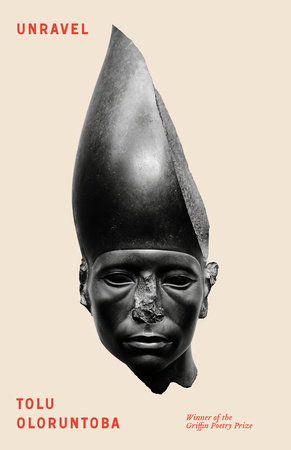
Finalist for the 2025 National Book Critics Circle Award for Poetry • A Calgary Herald bestseller • Named a Best Canadian Poetry Book of 2025 by CBC Books
“Although composed of ever fragmenting parts, Unravel feels complete. Grounded in centuries of literary and scientific references—from the Bible to Jacques Derrida and contemporary therapists—these lines are dense and reinvigorating. ‘I became a question // for myself,’ Oloruntoba writes, quoting Saint Augustine, whose Confessions are felt throughout this similarly forceful and expansive record of self-exploration.”
—Literary Review of Canada
“Oloruntoba’s use of forms such as the cento and the found poem is indicative of the volume’s overall tendency to unravel historic approaches or understandings and recombine them . . . On a linguistic level, this unravelling takes the form of breaking down binaries (see, for example, the early poem “Contronym”) and locating the play in syntactical forms.”
—Quill & Quire
“For everyone who’s been cautioned they’re overthinking things:…Unravel is a seeker’s book, exploring making and unmaking, doing and undoing, the twin existential horrors of ending and endlessness. It is heartfelt and clever, probing and funny, putting God and gods in its sights alongside other human creations—language, art, drama.”
—The Tyee
“’Everything is coda in a never-ending world,’ writes Tolu Oloruntoba in his spectacular third book. Spiralling through a myriad of histories, experiences, and dictions, the language’s momentum is modulated by Oloruntoba’s deft control of line and syntax. This tension, this craft, enables Oloruntoba to slow and to explore the bewildering and fascinating ruptures in self-making, world-making. This is symphonic and soaring poetry.”
—Eduardo C. Corral, author of Guillotine
“Unravel by Tolu Oloruntoba is a dope and fascinating collection of poetry that navigates the intersections of identity, migration, fatherhood, and history. A vivid poetic digging in the crates, it threads through the many layers of Whitman’s multitudes: the Nigerian self, riffing on memories of home; the immigrant self, navigating displacement and belonging; the father self, reflecting on his new born daughter; and the literary self, referencing a rich reading history. Unravel lingers in the mind as a testament to Oloruntoba’s ability to blend intellect and emotion into unforgettable verse.”
—Reginald Dwayne Betts, author of Felon
“This stunning collection of poems is a searing, prophetic commentary on the banalities of late modern life. The language is shot through with philosophical brilliance and spiritual energy. These poems play with diction in a way that is deadly serious—even apocalyptic, unveiling something of the world and ourselves.”
—James K.A. Smith, Calvin University, author of How (Not) To Be Secular and How to Inhabit Time




 QUICK VIEW